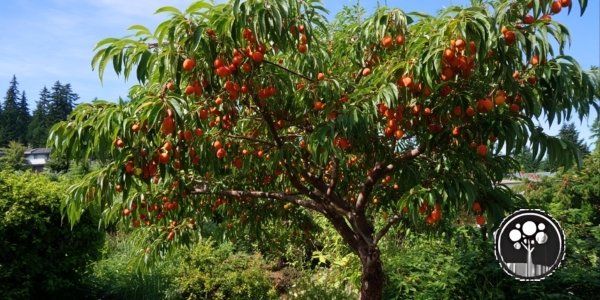

TL;DR — Quick Summary
Strategic pruning is the single biggest controllable factor in how much usable fruit a Vancouver backyard tree produces. This ISA-certified guide covers dormant vs summer pruning timing for apple, pear, plum, and cherry, which branches to remove, and open-centre vs central-leader form.
Two apple trees, planted the same spring on the same East Vancouver block, the same variety. Five years on, one drops a steady, manageable crop of clean, full-sized fruit every September. The other carries a tangle of crossing branches, a dense shaded interior, and a scatter of small, blemished apples it cannot reach the light to ripen properly. The trees are not different. The pruning is.
That is the central, testable claim of this guide, and it holds up in yard after yard across the Lower Mainland: strategic pruning, done at the right time and in the right form, is the single biggest controllable factor in how much usable fruit a backyard tree produces. Not fertilizer. Not the variety, once it is in the ground. Pruning. After more than 20 years pruning fruit and ornamental trees across Greater Vancouver, our ISA-certified arborists have seen the same pattern repeat too many times for it to be coincidence.
This guide explains the why and the when of fruit-tree pruning for Vancouver's climate — which cuts increase fruit, which season to make them in for apple, pear, plum, and cherry, and which tree form suits which fruit. It is written for the Vancouver homeowner with a few backyard trees. For larger jobs, or trees that have gone years without attention, an ISA-certified pruning service can reset the tree properly in a single visit.
The short version: prune your fruit trees primarily in late winter, while they are dormant, to build structure and stimulate growth; use lighter summer pruning to let light into ripening fruit and to slow over-vigorous trees. Open up the canopy so sun and air reach the inner branches, because that is where fruit quality is won or lost. And know which form your tree wants — open-centre for plums and most cherries, central-leader or modified-central-leader for apples and pears. The rest of this guide is the detail behind those rules.
Why Does Pruning Actually Increase Fruit Production?
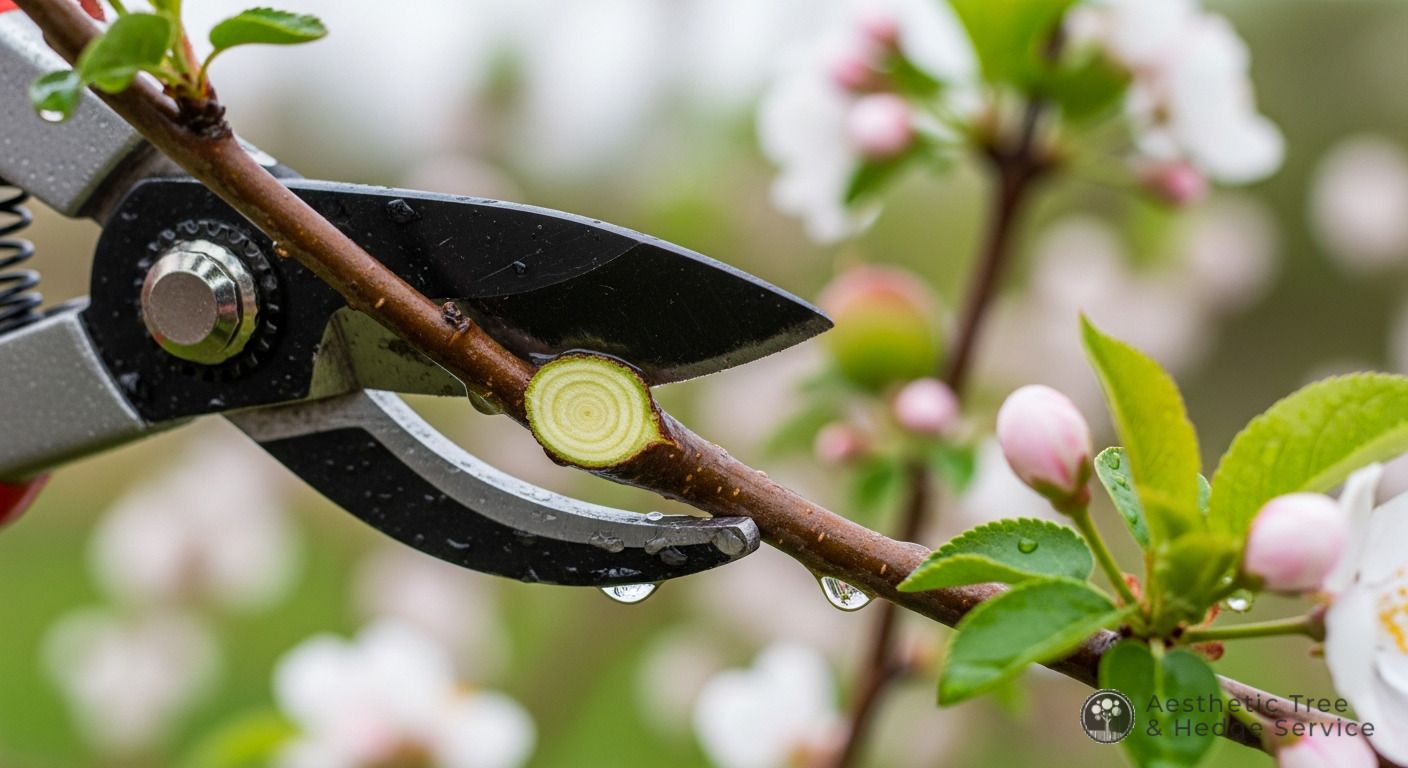
It seems backward. You remove wood from a tree and it gives you more fruit. The mechanism is worth understanding, because once you see it, every pruning decision becomes obvious.
A fruit tree has a fixed amount of energy in a given season. Left unpruned, it spends that energy on quantity — masses of small, crowded fruit, much of it in deep shade where it never sizes up or sweetens. Pruning redirects that energy. By removing excess and unproductive wood, you concentrate the tree's resources on fewer, better-placed fruit, and the result is larger, cleaner, properly ripened fruit you can actually use.
Light is the heart of it. Fruit ripens and develops sugar in sunlight. A dense, unpruned canopy shades its own interior, and fruit in that shade stays small, sour, and pale. Opening the canopy so sunlight reaches the inner and lower branches is the most direct way pruning improves a crop. Air movement matters almost as much: an open canopy dries faster after Vancouver's frequent rain, and that dramatically reduces the fungal diseases — apple scab is the classic Lower Mainland example — that thrive in the still, damp air of a crowded tree.
There is also a structural payoff. Removing weak, narrow-angled, and crossing branches builds a framework strong enough to carry a heavy crop without limbs breaking. A well-pruned tree holds its fruit. A neglected one tears itself apart in a good year.
When Is the Best Time to Prune Fruit Trees in Vancouver?
Timing is not a detail. The same cut made in February and in July produces a different response from the tree. There are two distinct pruning seasons, and they do two different jobs.
Dormant pruning - late winter, the main event
The primary pruning season for fruit trees in Vancouver is the dormant period — roughly January through early March, after the coldest weather but before the buds swell and growth begins. With the leaves gone, the structure of the tree is fully visible, so you can see exactly what to cut. More importantly, a dormant tree responds to pruning with vigorous new growth in spring, because its stored energy is concentrated into fewer growing points. Dormant pruning is how you build and renew the tree's framework. The one caution for our climate: prune on a dry spell rather than into wet weather, since open cuts in cool, damp conditions are an invitation to disease.
Summer pruning - lighter, for light and control
Summer pruning, generally done after the main flush of growth, serves the opposite purpose. Where dormant pruning stimulates growth, summer pruning slows it. It is the tool for an over-vigorous tree putting all its strength into leafy water sprouts instead of fruit. It is also how you let a final dose of sunlight onto ripening fruit in late summer by thinning the leafy growth shading it. Summer cuts should be lighter and more selective than dormant cuts — this is fine-tuning, not framework-building.
Stone fruit timing - a Vancouver-specific caution
Apples and pears (the pome fruits) tolerate dormant winter pruning well. Stone fruits — plum, cherry, peach — are more particular. They are more susceptible to bacterial and fungal diseases that enter through pruning wounds in cool, wet conditions, and deep-winter pruning in rainy Vancouver raises that risk. For stone fruit, many arborists prefer to do the work in dry summer weather, after harvest, when wounds seal quickly. If you have a plum or a cherry, this distinction matters — pruning it on the same February schedule as your apple tree is a common, avoidable mistake here.
Which Branches Should You Remove to Boost Fruit?
Effective fruit pruning is mostly subtraction, and there is a clear priority order. Work through it in this sequence and a tangled tree becomes a productive one.
Start with the three Ds: dead, diseased, and damaged wood. Remove all of it first. It produces nothing, it harbours disease and pests, and clearing it lets you see the tree's real structure. Next, take out crossing and rubbing branches — where two limbs touch, the constant abrasion wounds the bark and opens a door to infection; keep the better-placed branch, remove the other.
Then deal with water sprouts and suckers. Water sprouts are the vertical, whip-like shoots that rocket straight up from branches; suckers come up from the base or the rootstock. Both are vigorous, both are largely unproductive, and both steal energy and cast shade. Remove them. After that, thin the canopy: take out enough inward-growing and overcrowded branches that light and air reach the centre of the tree. The old orchardist's test still works — the canopy should be open enough that a bird could fly through it.
Two rules govern every cut. First, make clean cuts just outside the branch collar — the slightly swollen ring where a branch joins a larger limb — never flush to the trunk and never leaving a long stub; the collar contains the tissue the tree uses to seal the wound. Second, observe the roughly one-quarter rule: avoid removing much more than a quarter of the tree's live canopy in a single year. Over-pruning shocks the tree and triggers a forest of water sprouts — exactly the unproductive growth you were trying to remove. Restoring a badly neglected tree is a project spread over two or three seasons, not one aggressive afternoon.
What Tree Shape Produces the Most Fruit?
Beyond individual cuts, the overall form you train a tree into shapes its lifetime productivity. Two forms cover most backyard fruit trees in Vancouver.
Open-centre (vase) form
The open-centre or vase form has no central trunk in the upper tree. Instead, three to five main scaffold limbs spread outward and upward from a short trunk, leaving the middle of the tree open to the sky. The advantage is light: sun pours straight into the heart of the canopy, which is ideal for fruit quality. This form suits plums, most cherries, and peaches — the stone fruits — and it keeps the tree lower and easier to harvest and net against birds.
Central-leader and modified-central-leader form
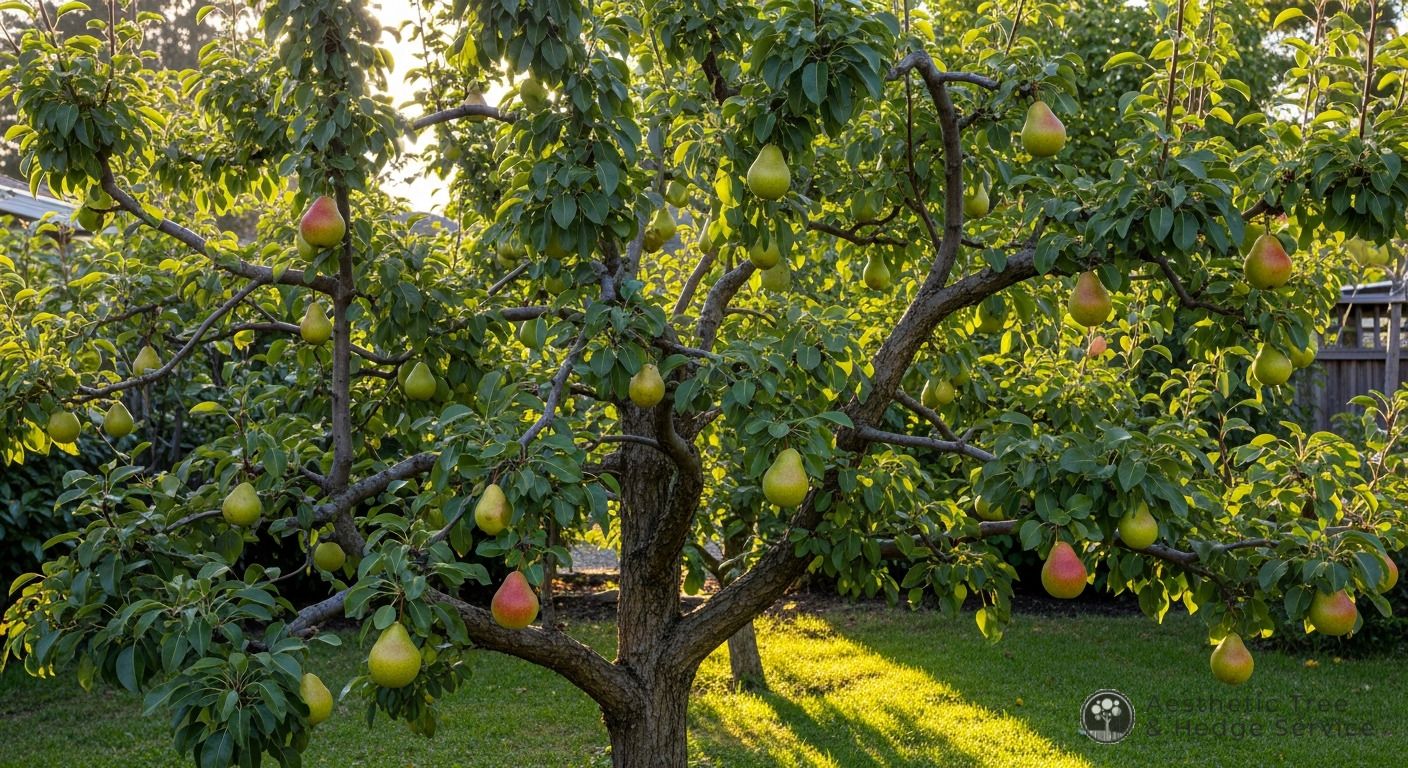
The central-leader form keeps a single dominant vertical trunk with branches arranged in tiers around it, producing a roughly conical, pyramidal tree. It is the classic form for apples and pears, giving a strong structure that carries heavy crops well. Many home growers use a modified-central-leader compromise: the tree is trained with a central leader while young to build structure, then the leader is cut back once the tree reaches a manageable height, which keeps the fruit within reach of a homeowner on the ground rather than a ladder.
The practical point is to know which form your tree is, or should be, and prune toward it consistently. A tree pruned with no form in mind — a cut here, a cut there, year after year — slowly loses its structure and its yield. Establishing the right form in a young tree is far easier than rebuilding it in an old one, which is one of the best reasons to bring in a certified arborist early in a fruit tree's life.
How Do Vancouver's Conditions Affect Fruit-Tree Pruning?
Generic fruit-pruning advice is written for a generic climate. Vancouver is not generic, and three local conditions change how you should prune.
First, the wet. The Lower Mainland's high rainfall and long, damp, mild winters create near-ideal conditions for fungal and bacterial tree diseases. Apple scab, brown rot in stone fruit, and bacterial canker are all common here. Good pruning is part of the defence: an open, well-thinned canopy dries faster and stays healthier, and timing cuts for dry weather keeps wounds from becoming infection sites. In Vancouver, pruning is as much a disease-management practice as a yield practice.
Second, the mildness. The region's mild winters and zone-8 conditions suit a wide range of fruit — apple, pear, plum, and cherry all do well, and the dormant season is comfortably long enough for winter pruning. Late frosts during bloom can occasionally damage a crop, but the climate is broadly generous to fruit growers, and a well-pruned tree makes the most of it.
Third, urban space. Most Vancouver fruit trees grow on modest city lots, close to fences, houses, and neighbours. Pruning here is also size management — keeping a tree productive while keeping it inside the space it has. This is where the modified-central-leader form and disciplined annual pruning earn their keep: they let a homeowner keep a genuinely productive fruit tree in a small backyard without it overwhelming the property or the neighbour's.
Frequently Asked Questions
When should I prune fruit trees in Vancouver?
The main pruning season is the dormant period — roughly January through early March — after the coldest weather but before the buds swell. Dormant pruning builds structure and stimulates strong spring growth, and the bare branches make the tree's framework easy to read. Lighter summer pruning, done after the main growth flush, slows an over-vigorous tree and lets sunlight onto ripening fruit. One Vancouver caution: stone fruits like plum and cherry are often better pruned in dry summer weather rather than in the wet winter, because their wounds are more vulnerable to disease.
Does pruning really increase how much fruit a tree produces?
Yes — though the better way to say it is that pruning increases the amount of usable fruit. An unpruned tree often sets masses of small, shaded, poor-quality fruit. Pruning redirects the tree's fixed seasonal energy into fewer, better-positioned fruit, and opens the canopy so sunlight reaches them to size and sweeten the crop. The result is larger, cleaner, properly ripened fruit and a stronger branch structure that can carry it. Quantity may fall; usable harvest rises.
How much of a fruit tree can I safely prune in one year?
As a general rule, avoid removing much more than about one-quarter of the tree's live canopy in a single season. Over-pruning shocks the tree and provokes a flush of vigorous, unproductive water sprouts — the opposite of what you want. If a tree has been neglected for years and needs major work, spread the restoration over two or three seasons rather than doing it all at once. A certified arborist can stage that kind of recovery plan for you.
What is the difference between open-centre and central-leader pruning?
Open-centre (or vase) form has no upper trunk — several scaffold limbs spread outward from a short trunk, leaving the middle open to the sky for maximum light. It suits stone fruits: plum, cherry, and peach. Central-leader form keeps a single dominant vertical trunk with tiered branches, making a conical tree well suited to apples and pears. Many home growers use a modified-central-leader form, training a leader while the tree is young and then cutting it back to keep the fruit within easy reach.
Should I prune my plum and cherry trees at the same time as my apple tree?
Not necessarily. Apples and pears (pome fruits) tolerate dormant winter pruning well. Plums and cherries (stone fruits) are more susceptible to bacterial and fungal diseases that enter through pruning wounds in cool, wet weather, so in rainy Vancouver many arborists prefer to prune stone fruit in dry summer conditions, after harvest, when cuts seal quickly. Pruning a plum on the same February schedule as an apple is a common local mistake worth avoiding.
When should I hire an arborist instead of pruning a fruit tree myself?
Light annual pruning of a small, healthy, well-shaped fruit tree is well within reach of a careful homeowner. Bring in an ISA-certified arborist when the tree is large, when it has gone several years without pruning and needs a staged restoration, when you are establishing the form of a young tree and want it done right from the start, or when disease is present and cuts must be made carefully to avoid spreading it. An arborist can also handle high or awkward work safely, which is the point at which a do-it-yourself prune stops being worth the ladder.
Get More From Your Vancouver Fruit Trees This Season
A backyard fruit tree is one of the most rewarding things you can grow on a Vancouver lot — and the difference between a tree that frustrates you and a tree that feeds you is almost always the pruning. Make the structural cuts in the dormant late-winter window, use lighter summer pruning to manage light and vigour, open the canopy so the sun can do its work, and prune toward the right form for the fruit you are growing. Treat plums and cherries with their own dry-season timing. Do that consistently and the results show up in the harvest basket.
Aesthetic Tree & Hedge Services has pruned fruit and ornamental trees across Vancouver, Burnaby, the North Shore, and the Tri-Cities for more than 20 years. Whether you have a young tree to train, a neglected tree to restore, or a tree too large to prune safely from the ground, our ISA-certified pruning service can assess it and prune it for genuine, lasting productivity. Contact our team to book a visit.
This article describes general fruit-tree pruning practice for the Vancouver climate and is not a substitute for an on-site assessment of a specific tree. Pruning principles referenced reflect established arboricultural practice and ISA Best Management Practices for tree pruning. Written by the ISA-certified arborists at Aesthetic Tree & Hedge Services. Copywriter voice: Claude Hopkins.
Understanding the relationship between pruning and fruiting is central to all certified arborist practice. If you want to go deeper on seasonal timing across all species, our guide on when is the best time to prune trees in Vancouver covers dormant-season versus growing-season cuts with the same ISA-grounded approach, and explains why the rules differ for conifers, ornamentals, and fruit trees.
Structural pruning for fruit production sits alongside another discipline worth understanding: for ornamental trees such as willows and planes, tree pollarding in Vancouver is the ISA-certified technique — and a common mistake is applying pollarding logic to fruit trees, which produces the opposite of what you want. Our certified crew corrects this misapplication every season.
If a formal written evaluation of your fruit tree's structure would help — for example, before a major renovation prune on a neglected older tree — our arborist report Vancouver service documents co-dominant stems, deadwood, and root concerns before the pruning plan is finalised. For the complete range of crown and canopy work our certified crews perform, visit our tree cutting Vancouver service page or browse the full tree services hub.
Additional Considerations
Tired of poor quality fruits? Pruning is an essential method of improving the vitality of a tree and hence its fruit. Learning when and how to prune fruit trees is an essential art that a landscape caretaker should possess. A number of reasons cannecessitate pruning. When a fruit tree is growing vertically with no side branches, pruning can stimulate the growth of branches at desired points. Pruning generally stimulates growth and can help your fruit trees increase in height.
Do you have a tree with uneven branches or even a fruit tree that is too tall? All these undesirable characteristics in your fruit trees can be corrected through pruning.
Size control of the tree. Some tree can be too tall or even grow huge unstable branches. Pruning can help a fruit farmer achieve desired tree sizes.
Removal of damaged wood. Tree disease and insect infestation can result to dead branches and wood that can cause further injury to the tree if not removed.
Helping a tree achieve a strong structure. Pruning tames upward growth allowing for thickening of trunks. This improves the strength of the tree allowing it to hold more fruits.
For development of a strong tree structure theinitial pruningis very essential. Thereafter pruning is not necessary often unless under the special conditions outlined above. Trees should be pruned when they are still in the dormant phase before buds start sprouting. This period is just at the start of spring or during late winter. Pruning at this point provide numerous advantages to your trees. When active growth resumes the wounds heal fast. At this point when there are no leaves on the tree, it is easy to identify the damaged branches and undesirable branches. It is important to note that pruning during winter can cause damage of the trees by the subzero temperatures that occur.
The first three years should be dedicated to removal of secondary stem s, downward growth, crossing branches and managing the scaffold. The scaffold branch forms the basic framework of a tree. All the branches that develop from the scaffold are the secondary branches. In immature trees pruning is only necessary to remove downward weak branches, dead wood and water sprouts. Fruit trees that have been neglected require special attention since the hard wood can easily break or split.
Young tree should be pruned right after plantin g. The main trunk should be trimmed down to between 24 and 34 inches. This however depends on the height requirement of the mature tree. If a tall fruit tree that can provide shade is desired then the cut should be made at a higher point on the young tree. If a fruit tree is not growing well during the first three years, heavy pruning is allowed.
- The first step should be cleaning up all the dead, damaged and diseased branches. Any sprouting at the base of the trunks should also be removed. Water sprout are the perfectly vertical twigs emanating from branches. These should also be removed.
- Thinning out. This will involve theremoval of branchescrossing each other those growing downwards and towards the center. This improves the penetration of light which reduces incidences of pests and disease infestation and hence increasing yield. Thinning out should achieve a distance of between 6 – 12 inches between branches depending on the size of the branches.
Selection of the tool depends on the thickness of the branches. The required tools range from hand shears, loppers, fine toothed pruning saw and a ladder. Shear are a scissor type used to cut small branches up to a quarter an inch in diameter. Loppers can be used on branches between a quarter and a half inches of diameter. The saw is necessary in the thicker branches and in heights where the other two tools cannot be used. This is mostly at the third year of growth. The ladder should prevent the pruner from stepping on the branches to avoid breakage. Cutting should be made close to the remaining branch to avoid leaving a stub.
Found this helpful? Follow our tree care insights directly on Google.
Make us your preferred source on GoogleBefore You Go
Where are you in your tree care journey?
Our Tree Care Services
ISA-certified arborists serving Greater Vancouver


Explore Our Tree Care Services
From expert pruning to safe tree removal, our ISA-certified arborists are ready to help across Greater Vancouver.
View Services