
TL;DR — Quick Summary
transplanting trees vancouver? Learn when moving a tree works, when permits apply, and how an ISA-certified arborist protects roots.
transplanting trees vancouver sounds simple until roots, bylaws, soil, drainage, and access get involved.
A tree isn’t patio furniture.
You don’t just “move it over there.”
You disturb the root system. You change its light. You change its water. You cut fine absorbing roots. You expose it to stress at the worst possible time.
Done right, transplanting saves a valuable tree.
Done wrong, it turns a living asset into a slow failure.
At Aesthetic Tree & Hedge Services, we look at transplanting through an arborist lens first. Not a landscaping lens. The question isn’t only, “Can this tree be moved?”
The better question is this:
Should it be moved at all?
TL;DR
- Tree transplanting works best with smaller, healthy trees that have a manageable root ball and a clear reason to move.
- In Vancouver, protected trees and development sites often trigger permit, protection, or arborist report requirements.
- Timing matters. Late fall and dormant-season work give transplanted trees the best start in the Lower Mainland.
- Root flare depth, root ball size, soil prep, watering, and aftercare decide whether the tree recovers.
- If transplanting creates too much risk, tree preservation, pruning, replacement planting, or permitted removal may be the better call.
Can You Transplant a Mature Tree in Vancouver?
Yes, you can transplant some mature trees in Vancouver.
But “can” isn’t the same as “should.”
A tree’s moveability depends on five things:
- Species
- Size
- Health
- Root condition
- Site access
A young Japanese maple in Kitsilano is one conversation. A mature Douglas fir near a foundation in North Vancouver is another.
The bigger the tree, the bigger the root loss.
That’s the hard truth.
Most tree roots sit in the upper soil layer. They spread wide, often far past the drip line. When a tree is dug out, only a portion of that root system comes with it.
That’s transplant shock.
And transplant shock is why the first inspection matters.
An ISA-certified arborist checks:
- The root flare
- Trunk diameter at breast height, or DBH
- Canopy density
- Deadwood
- Included bark
- Root girdling
- Soil compaction
- Drainage
- Nearby utilities
- Access for crew and equipment
Species matters too.
Some trees tolerate moving better than others. Smaller maples, ornamental cherries, dogwoods, and young cedars are common candidates. Large conifers, old Big-leaf maples, and declining trees are harder.
A cedar with a healthy root plate and good access has a better case. A stressed cedar in compacted soil beside a driveway does not.
In our site visits across Vancouver, Burnaby, Richmond, Coquitlam, and the North Shore, the best transplant candidates share one trait.
They have room.
Room to dig. Room to lift. Room to replant. Room for roots to recover.
No room means no margin.
And trees need margin.
When Is Tree Transplanting Better Than Tree Removal?
Tree transplanting is better than removal when the tree has high value and a fair chance of survival.
That value can be practical.
A healthy cedar screen may block a neighbour’s second-storey window. A Japanese maple may anchor a front yard. A young fruit tree may have years of production ahead. A city-approved replacement tree may need to stay on site.
That value can also be regulatory.
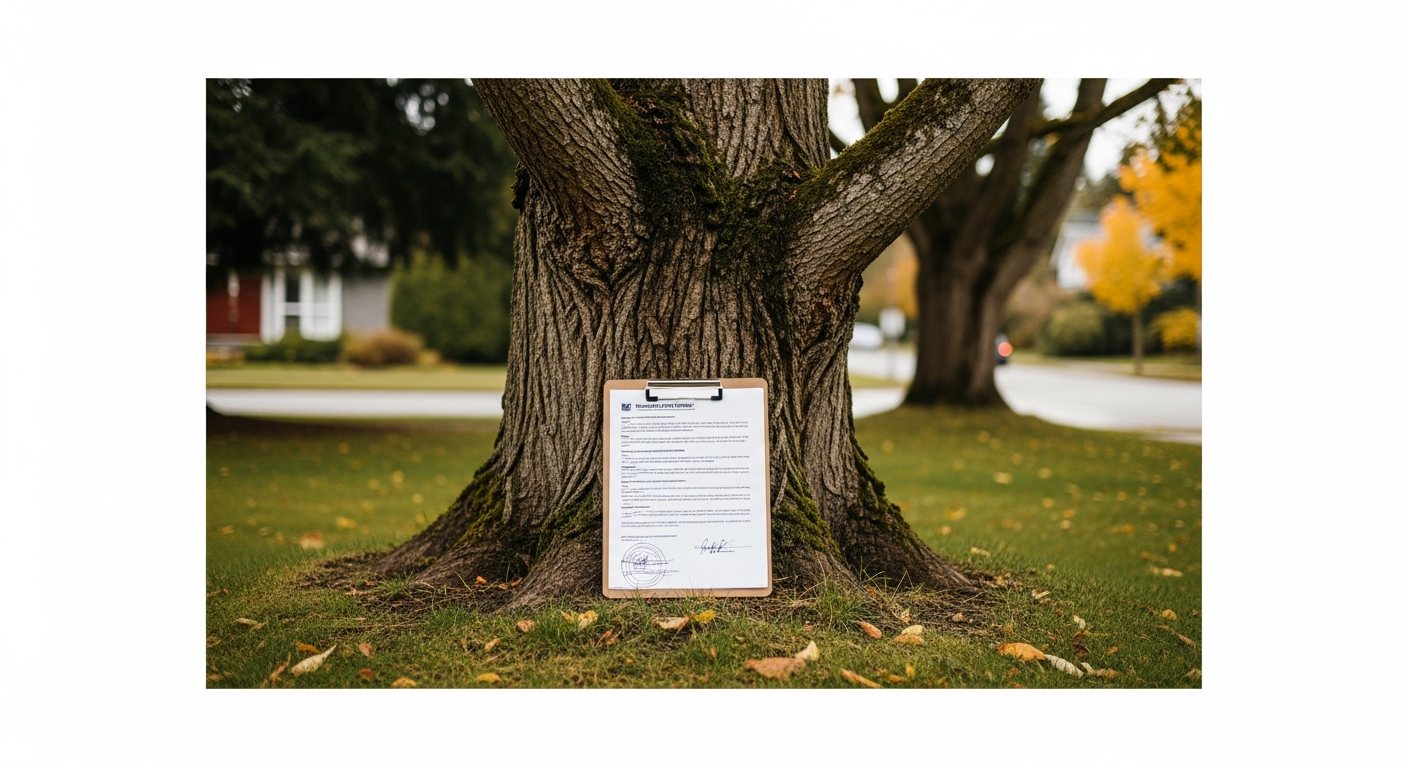
The City of Vancouver’s Protection of Trees By-law No. 9958 applies to private property trees. According to the City of Vancouver’s current tree bylaw guidance, a permit is required to remove a private property tree with a diameter of 20 cm or more, measured 1.4 metres above ground.
That single number changes the plan.
If a protected tree blocks a renovation, the first step is not a saw. It’s assessment.
Can the design shift?
Can the root zone be protected?
Can the tree be retained?
Can it be transplanted?
If removal is the only sound option, the permit path needs to be handled correctly. For that, homeowners often need an arborist report in Vancouver before work moves ahead.
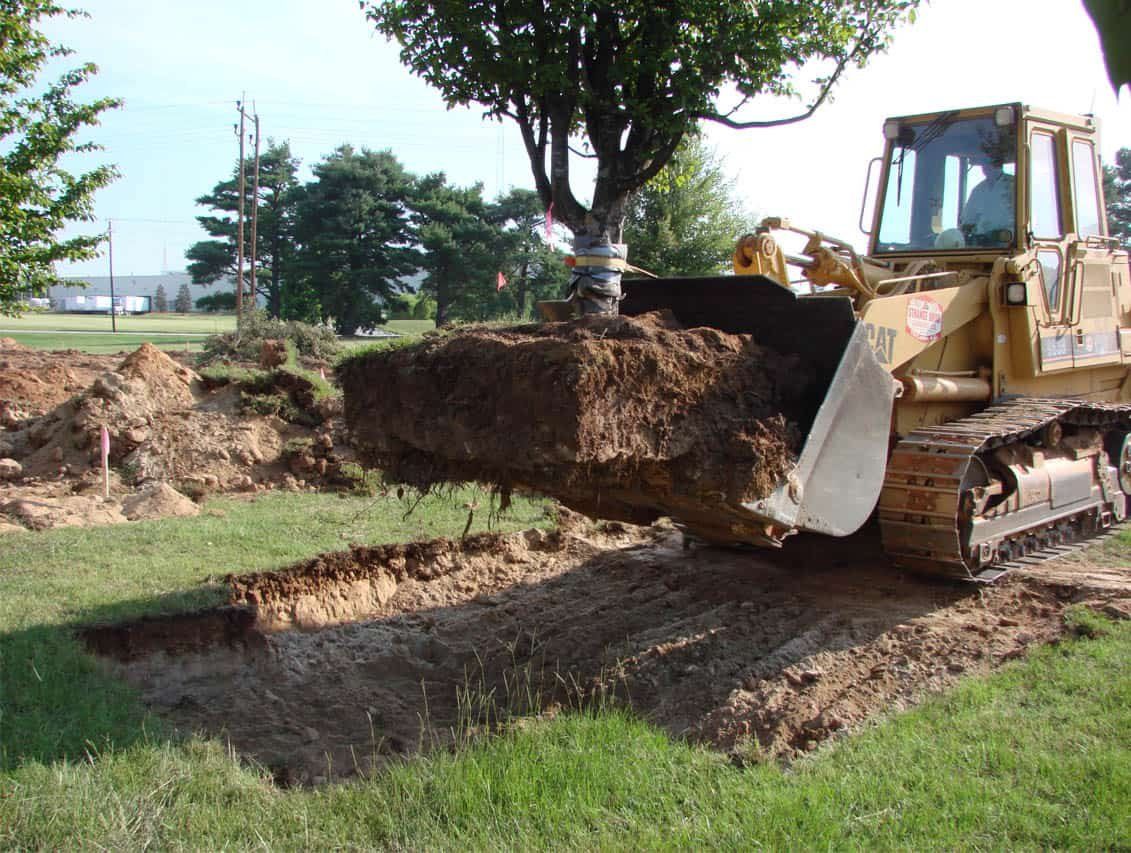
Transplanting also makes sense when the tree is small enough to move without excessive root loss.
A 6 cm caliper ornamental tree is often worth discussing. A 60 cm DBH fir is a very different risk profile.
Here’s the no-nonsense test we use:
Will moving this tree preserve more value than it risks?
If yes, transplanting belongs on the table.
If no, the better path may be pruning, retention planning, replacement planting, or permitted tree removal in Vancouver.
The goal is not to “save” every tree at any cost.
The goal is to make the right arboricultural decision.
What Vancouver Tree Bylaws Affect Transplanting?
Vancouver tree bylaws matter because transplanting often happens during renovation, demolition, drainage work, or yard redesign.
Those projects can affect protected trees.
In Vancouver, the City’s Protection of Trees By-law No. 9958 sets the main rule for private property tree removal. A permit is required for removal of a tree 20 cm DBH or larger. The City also states that development applications involving trees 20 cm or larger require an arborist report.
That matters even if your goal is transplanting, not removal.
Why?
Because the City looks at tree impact.
Root cutting, grade changes, trenching, excavation, and heavy equipment can damage retained trees. A tree doesn’t need to be cut down to be harmed.
Other Lower Mainland municipalities have their own rules.
According to the City of Burnaby’s current tree guidance, property owners generally don’t need a permit to remove trees smaller than 30 cm in diameter unless the tree is protected. Burnaby also states that replacement trees are required as a condition of a Tree Cutting Permit.
According to the City of Richmond’s Tree Protection Bylaw No. 8057 guidance, cutting or removing a tree larger than 20 cm DBH generally requires a permit. Richmond also states that topping trees is prohibited and can lead to fines up to $50,000 per tree.
According to the City of North Vancouver’s private tree guidance, a permit is required to remove a protected tree with a diameter of 20 cm or greater, measured 1.4 metres above ground. The City also requires an arborist report for permit applications.
So the first question is not “Where do you want the tree?”
It’s this:
Which municipality are we in, and what does the bylaw require?
That’s why local arborist knowledge matters.
Vancouver, Burnaby, Richmond, North Vancouver, and Coquitlam do not treat every tree the same way. The wrong assumption can delay a project or create an avoidable bylaw issue.
If a tree is protected, tied to a development permit, or listed as a replacement tree, get the paperwork checked before anyone digs.
What Makes a Tree a Good Candidate for Transplanting?
A good transplant candidate is healthy, young enough to recover, and growing in a location that allows a proper root ball.
That sounds simple.
It isn’t.
A tree can look fine from the sidewalk and still be a poor candidate.
We inspect above and below the visible line.
Health
A healthy tree has strong annual growth, good leaf density, sound branch attachments, and no major trunk defects.
Warning signs include:
- Sparse canopy
- Dead limbs
- Cracks
- Fungal fruiting bodies
- Bleeding bark
- Root damage
- Severe lean
- Poor taper
A stressed tree has less stored energy. Moving it adds stress. That combination fails fast.
Species
Some species handle root disturbance better.
Ornamental maples, small deciduous trees, and younger hedging cedars often respond well when moved in season. Large conifers, old specimens, and trees with taproots are harder.
Western red cedar can transplant well at smaller sizes. Large cedars are heavier, denser, and more sensitive to root loss.
Big-leaf maple can be vigorous, but mature specimens need careful review. Douglas fir needs special caution because it depends on a stable root system and wide soil volume.
Size
Smaller trees win.
That’s not opinion. It’s biology.
The larger the trunk, the larger the root system needed to support it. A bigger root ball means more weight, more equipment, more site disruption, and more aftercare.
ANSI A300 Part 6 covers planting and transplanting standards for woody plants. The Tree Care Industry Association identifies root ball size and tree spade work as part of this standard.
In plain English:
The root ball must match the tree.
Too small, and the tree loses too many roots.
Too shallow, and the tree dries out.
Too deep, and the root flare gets buried.
Site Access
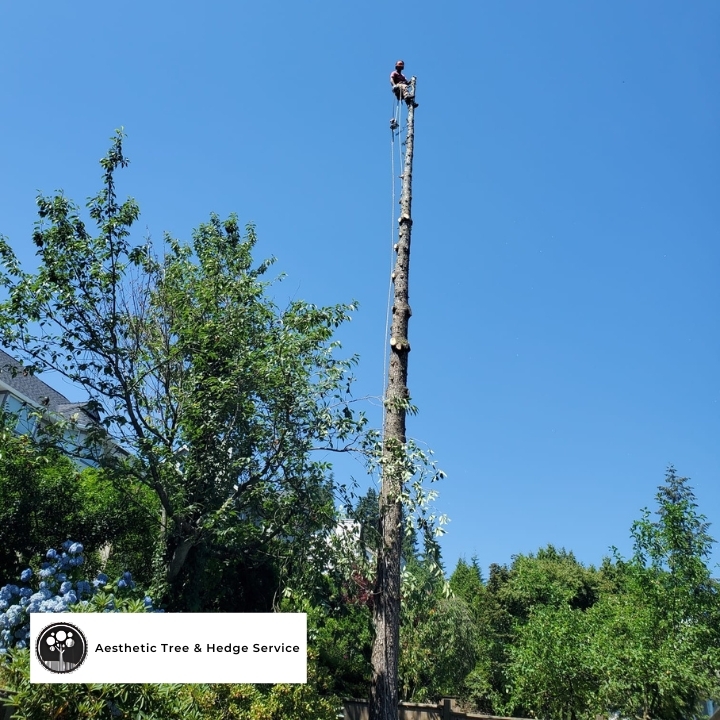
Access decides what’s practical.
Can equipment reach the tree?
Is there a fence in the way?
Are there stairs, retaining walls, overhead wires, parked cars, or narrow side yards?
A backyard in Mount Pleasant with a 30-inch gate is not the same as a wide lot in Shaughnessy.
When access is tight, hand digging and rigging increase. That changes the risk and the work plan.
Destination Site
The new site must fit the tree’s future size.
Not today’s size.
Future size.
A small cedar planted too close to a house becomes a maintenance problem. A maple planted over utilities becomes a conflict. A tree planted into poor drainage declines from the roots up.
Good transplanting starts before the tree moves.
The new hole, soil, drainage, light, mulch, and watering plan all need to be ready.
When Is the Best Time to Transplant Trees in Vancouver?
The best time to transplant most trees in Vancouver is during dormancy, from late fall through early spring.
That window usually gives roots a better recovery path.
Why?
Cooler temperatures reduce water demand. Rain helps soil moisture. The tree is not pushing new leaves, flowers, or fruit. Root growth can restart before summer stress hits.
In the Lower Mainland, late October through March is often the strongest window.
But site conditions still rule.
Don’t transplant into saturated soil that smears and compacts. Don’t move a tree during a freeze. Don’t dig when heavy equipment will crush the root zone.
Summer transplanting is risky.
It can be done for select trees with tight controls, but heat and drought raise the stakes. Vancouver summers are drier than many homeowners think. Transplanted trees lose fine roots first, and those are the roots that take up water.
According to the City of Vancouver’s 2025 Urban Forest Strategy, Vancouver’s canopy cover reached about 25% in 2022, up from 23% in 2018 and 21% in 2013. The same strategy sets a 30% canopy cover target by 2050.
That citywide push matters at the property level.
Mature canopy is valuable. But moving a tree at the wrong time can waste that value.
The best transplant schedule is built around the tree, not the contractor calendar.
If a renovation timeline forces summer work, ask about options first. Temporary root protection, design changes, pruning, watering, or staged work may protect the tree better than moving it under stress.
For seasonal planning, our guide to seasonal tree care explains how Vancouver weather changes pruning, planting, and maintenance timing.
How Does an Arborist Transplant a Tree Properly?
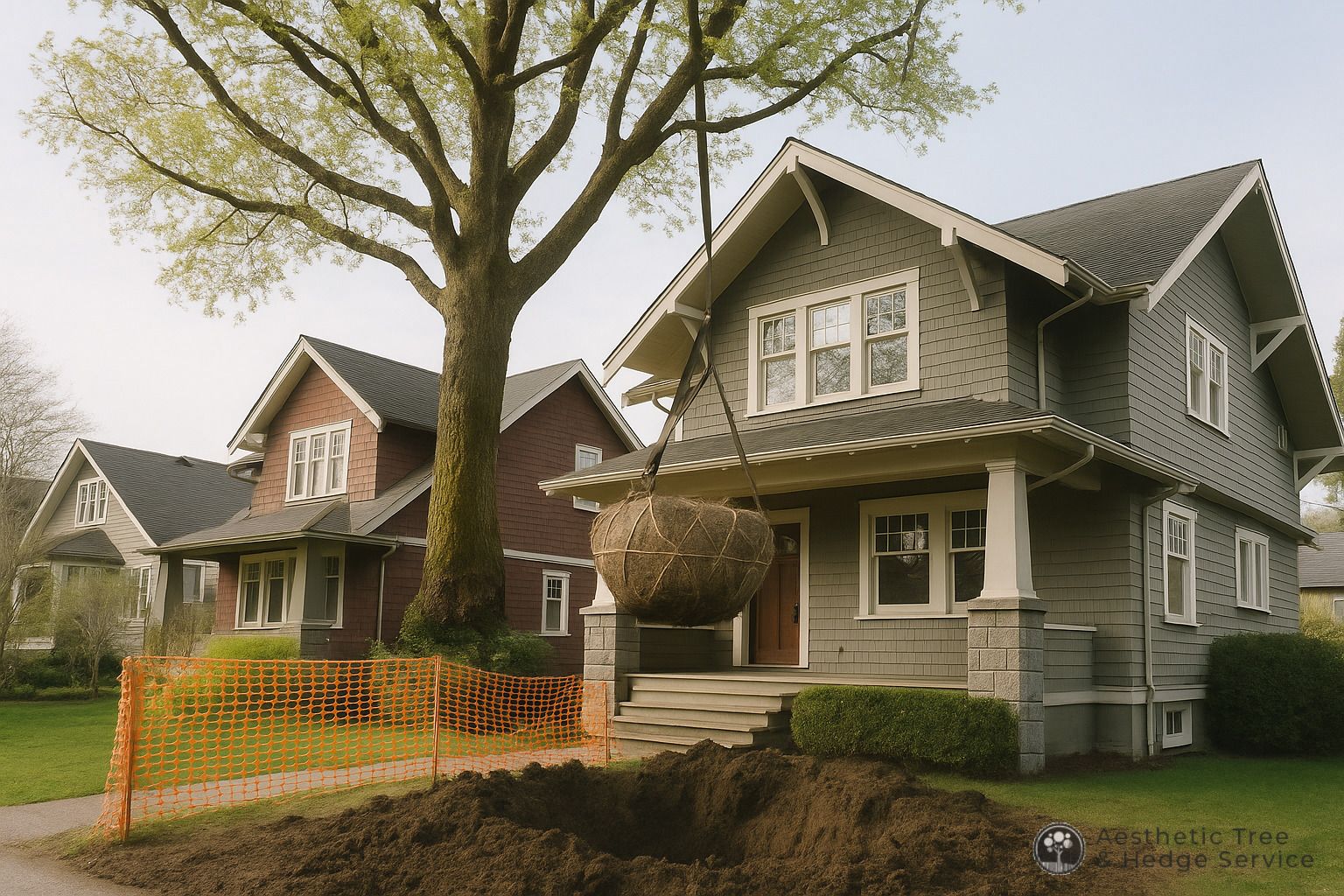
A proper tree transplant starts with assessment, not digging.
Here’s the field process.
1. Assess the Tree
We inspect health, structure, species, size, soil, access, and destination conditions.
If the tree is protected or tied to construction, we check the bylaw path. If the tree is too risky to move, we say that early.
No homeowner benefits from false hope.
2. Confirm the Root Ball
The root ball must carry enough roots to support recovery.
A small root ball is easy to move. It is also easy to kill.
A proper root ball is heavy, awkward, and planned with care. It needs depth, width, moisture, and support.
The root flare must stay visible.
That point matters.
The root flare is where the trunk transitions into the root system. If it gets buried, the tree can develop decay, girdling roots, and long-term stress.
3. Prepare the New Location
The new planting site needs to be ready before the tree leaves the ground.
That means:
- Correct hole width
- Correct hole depth
- Stable base
- Good drainage
- No buried debris
- No compacted hardpan
- Room for mature roots
- Water access
- Mulch plan
The planting hole should not be a deep bucket.
It should support roots spreading outward.
4. Dig and Lift
Digging cuts roots. That part is unavoidable.
The work is to control the cuts.
Sharp cuts heal better than torn roots. Clean handling protects the root ball. Fast transfer reduces drying. The crew must keep the root ball intact from lift to placement.
For large trees, this may involve equipment, rigging, mats, or a tree spade. For small trees, hand work may be enough.
5. Set the Tree at the Right Height
Planting too deep is one of the most common failures.
The root flare should sit at or slightly above finished grade.
Not under soil.
Not under mulch.
Not hidden by a raised bed.
6. Backfill and Water
Backfill should support the root ball without air pockets. Water settles soil around roots. Mulch protects soil moisture and temperature.
Do not mound mulch against the trunk.
That creates decay risk.
A proper mulch ring looks like a doughnut, not a volcano.
7. Monitor Aftercare
Transplanting is not finished on moving day.
That’s when recovery starts.
Watering, inspection, mulch maintenance, and stress checks matter for at least the first two growing seasons.
According to the South Carolina Forestry Commission’s newly planted tree survival guidance, many newly planted trees fail within one or two years, and root establishment practices sharply improve survival. The same guide notes that a 10-inch tree can require at least 13 growing seasons to restore its root system to pre-transplant size.
That’s the point homeowners often miss.
The tree is not “back to normal” when it stands upright.
It’s in recovery.
How Do You Reduce Transplant Shock After Moving a Tree?
You reduce transplant shock by protecting roots, controlling water, avoiding over-pruning, and giving the tree time.
Transplant shock shows up as:
- Wilting
- Leaf scorch
- Early leaf drop
- Sparse growth
- Dieback
- Needle browning
- Delayed bud break
Some stress is normal.
Severe stress is not.
Water Deeply, Not Randomly
Newly transplanted trees need consistent soil moisture.
Not swampy soil.
Not dry soil.
Consistent moisture.
The root ball dries faster than surrounding soil. That’s why watering must target the root ball and nearby soil, not just the lawn around it.
A slow soak works better than a quick spray.
Mulch Correctly
Mulch helps retain moisture and reduce temperature swings. It also protects soil from compaction.
Keep mulch away from the trunk.
A clear gap around the root flare protects bark.
Aesthetic Tree offers mulching services when soil protection and moisture control are part of the care plan.
Don’t Over-Prune
Old advice often said to prune the canopy hard after transplanting.
That is not the default today.
Leaves produce energy. Removing too much canopy reduces the tree’s ability to recover.
We remove dead, damaged, crossing, or structurally weak branches as needed. We don’t strip a healthy canopy to “balance” root loss without a reason.
When pruning is needed, it should follow ANSI A300 standards.
Protect the Root Zone
After transplanting, keep heavy traffic off the soil.
No parked vehicles. No material storage. No construction debris. No trenching through the root zone.
Compaction removes oxygen from soil.
Roots need oxygen.
Watch for Secondary Problems
A stressed tree attracts problems.
Borers, fungal issues, drought stress, and root rot can follow poor transplanting.
Early inspection is cheaper than late rescue.
If a transplanted tree starts leaning, cracking, dropping large limbs, or showing sudden canopy failure, treat it as a safety issue. Call an arborist. If there’s immediate risk to a house, driveway, sidewalk, or power line area, use emergency tree service.
What Trees Are Hard to Transplant in the Lower Mainland?
Trees are hard to transplant when they are large, stressed, poorly rooted, or species-sensitive.
In the Lower Mainland, we pay close attention to:
- Douglas fir
- Western red cedar
- Big-leaf maple
- Mature spruce
- Old fruit trees
- Trees in compacted clay
- Trees near retaining walls
- Trees growing over utilities
Large conifers deserve extra caution.
A mature conifer carries weight high in the canopy. If root loss weakens anchorage, safety becomes the issue.
That’s when transplanting shifts from “tree care” to hazard planning.
A hazard assessment looks at targets.
What would the tree hit if it failed?
A shed is one thing. A bedroom is another. A public sidewalk changes the risk again.
Root history matters too.
If the tree already had trenching nearby, driveway work, sewer work, or foundation excavation, the remaining root system may be compromised.
You can’t see that from a listing photo.
You need site review.
Hedges are different.
Cedar hedges can sometimes be moved in sections when they are young enough and access is good. But older hedges often decline after major root disturbance. If your real goal is privacy, hedge replacement or restoration may work better than transplanting.
For privacy screens, our hedge trimming services in Vancouver and hedge installation services can help compare care, repair, and replacement options.
The right answer depends on the tree’s job.
Shade tree?
Privacy screen?
Permit replacement?
Specimen feature?
Construction conflict?
Each job has a different threshold for risk.
What If Transplanting Isn’t the Right Option?
If transplanting isn’t the right option, you still have choices.
A good arborist doesn’t force one service into every problem.
Option 1: Preserve the Tree in Place
This is often the best result.
Construction plans can sometimes shift. Root protection zones can be fenced. Excavation can be adjusted. Pruning can create clearance. A root barrier can manage conflicts in select cases.
Aesthetic Tree provides root barrier installation when root management fits the site and the tree species.
Preservation works best early.
Call before the driveway is cut. Before the trench is open. Before the crew parks over the root zone.
Option 2: Prune for Clearance or Safety
Sometimes the tree doesn’t need to move.
It needs proper pruning.
Clearance from roofs, garages, service lines, and pathways can solve the conflict. Structural pruning can reduce limb failure risk. Crown cleaning can remove deadwood.
For branches, storm damage, or canopy conflicts, tree cutting in Vancouver may be the correct service.
The key is proper cuts.
Topping is not pruning.
Richmond’s bylaw guidance is blunt here. It states that topping is prohibited and can result in fines up to $50,000 per tree. Beyond the fine risk, topping creates weak regrowth and decay.
Option 3: Remove and Replace
Sometimes removal is the right arboricultural answer.
Dead tree. Hazard tree. Poor structure. Severe root damage. Wrong species in the wrong place. No viable transplant path.
In those cases, the work should be permitted, documented, and done safely.
After removal, the stump may also need to be addressed. If the stump blocks replanting, grade work, or a new path, stump grinding in Vancouver clears the site for the next step.
Option 4: Plant the Right Tree
Replacement planting is not a downgrade when done well.
It can be the better long-term decision.
The right species in the right location grows with fewer conflicts. It needs less corrective pruning. It fits the mature space. It supports canopy goals without creating future damage.
The City of Vancouver’s 2025 Urban Forest Strategy says the city aims to increase canopy coverage from about 25% in 2022 to 30% by 2050. The Park Board’s 2025 update also described planting about 165,000 new trees over 25 years as part of that canopy plan.
Private yards matter in that target.
A well-planted tree today becomes future shade, stormwater capture, and habitat.
Bad placement becomes a removal request.
For new trees, Aesthetic Tree offers tree planting services with species and site selection built into the plan.
How Should Homeowners Prepare Before Calling an Arborist?
Prepare by gathering facts before the site visit.
You don’t need to diagnose the tree yourself.
You do need to help the arborist see the full picture.
Have these ready:
- Your municipality
- Tree species, if known
- Approximate trunk diameter
- Photos of the tree from all sides
- Photos of the base and root flare
- Photos of the new planting location
- Reason for moving the tree
- Construction or permit timeline
- Any past excavation near the tree
- Any drainage issues
- Access limits, gates, stairs, slopes, or overhead wires
Measure the trunk at 1.4 metres above ground.
That’s DBH.
It helps identify permit triggers in many municipalities.
Also check whether the tree sits on private property, shared property, city boulevard, or a strata site. Ownership affects permission.
If the tree is near a property line, don’t guess.
Tree disputes get expensive fast.
If you’re working with a builder, designer, or excavation crew, bring the arborist in early. Arborist input after plans are final often costs more because the options are narrower.
Here’s the simplest order:
1. Identify the tree and municipality. 2. Check permit or arborist report needs. 3. Assess transplant viability. 4. Confirm destination site. 5. Plan timing. 6. Move only if the tree has a sound chance. 7. Follow aftercare.
That order protects the tree and the project.
Why Hire an ISA-Certified Arborist for Tree Transplanting?
Hire an ISA-certified arborist because tree transplanting is a health decision, a safety decision, and often a bylaw decision.
A general yard crew can dig a hole.
That’s not the same thing.
An arborist assesses whether the tree should be moved, how much root loss it can tolerate, what the bylaw requires, and what aftercare will protect the investment.
Aesthetic Tree & Hedge Services is ISA-certified and WCB registered. That matters on residential sites, construction sites, and tight Lower Mainland properties.
We follow arboriculture standards. We understand municipal tree rules. We look at risk before work starts.
You get a clearer answer:
Move it.
Preserve it.
Prune it.
Remove it with permit support.
Replace it with the right species.
That’s the point.
Not every tree should be transplanted.
But every tree deserves a proper decision.
FAQ
Can I transplant a tree myself in Vancouver?
You can transplant a small, unprotected tree yourself if it is manageable, healthy, and not tied to a permit or development condition. But larger trees need arborist review. If the tree is 20 cm DBH or larger in Vancouver, removal rules may apply. If construction is involved, get an arborist report before digging.
Do I need a permit to transplant a tree in Vancouver?
A simple transplant on private property may not need the same permit as removal, but protected trees, development sites, replacement trees, and root-zone impacts can trigger requirements. Vancouver requires permits for removing private trees 20 cm DBH or larger. Development applications with trees that size require arborist reports. Check before work starts.
What is the best season for transplanting trees in Vancouver?
Late fall through early spring is usually best. The tree is dormant, temperatures are cooler, and rainfall supports root recovery. Avoid hot summer moves unless an arborist confirms the tree, site, and aftercare plan can handle the stress.
How long does a transplanted tree need aftercare?
A transplanted tree needs close aftercare for at least two growing seasons. Larger trees need longer. Watering, mulch, root-zone protection, and inspection matter. A tree can stand upright and still be in transplant shock.
What should I do if my transplanted tree starts dying?
Call an ISA-certified arborist. Don’t start cutting, fertilizing, or overwatering without diagnosis. The cause may be drought stress, buried root flare, root damage, poor drainage, pest pressure, or planting depth. If the tree creates a safety risk, treat it as urgent.
Transplanting trees in Vancouver is worth doing when the tree, site, timing, and bylaw path all support it. Call Aesthetic Tree & Hedge Services for a free estimate at (604) 721-7370. Our ISA-certified, WCB registered arborists can assess the tree, explain your options, and help you make the right call before anyone digs.
Found this helpful? Follow our tree care insights directly on Google.
Make us your preferred source on GoogleBefore You Go
Where are you in your tree care journey?
Our Tree Care Services
ISA-certified arborists serving Greater Vancouver


Explore Our Tree Care Services
From expert pruning to safe tree removal, our ISA-certified arborists are ready to help across Greater Vancouver.
View Services