
TL;DR — Quick Summary
tree shrub essential vancouver guide for safer pruning, removal, hedges, permits, and storm prep. Call Aesthetic Tree for a free estimate.
Tree shrub essential vancouver care starts with one simple idea: your yard is living infrastructure.
That sounds formal. But it is also very practical.
A Douglas fir leaning toward a roof is not just a tree. A cedar hedge pressed against a sidewalk is not just a hedge. A Big-leaf maple with a split union is not just shade. Each one affects safety, drainage, privacy, property access, and local bylaws.
In Vancouver and the Lower Mainland, tree and shrub care needs more than a ladder and a saw. Our wet winters, dry summers, dense lots, overhead lines, and municipal tree rules all matter. So does the species. So does the root flare. So does the timing.
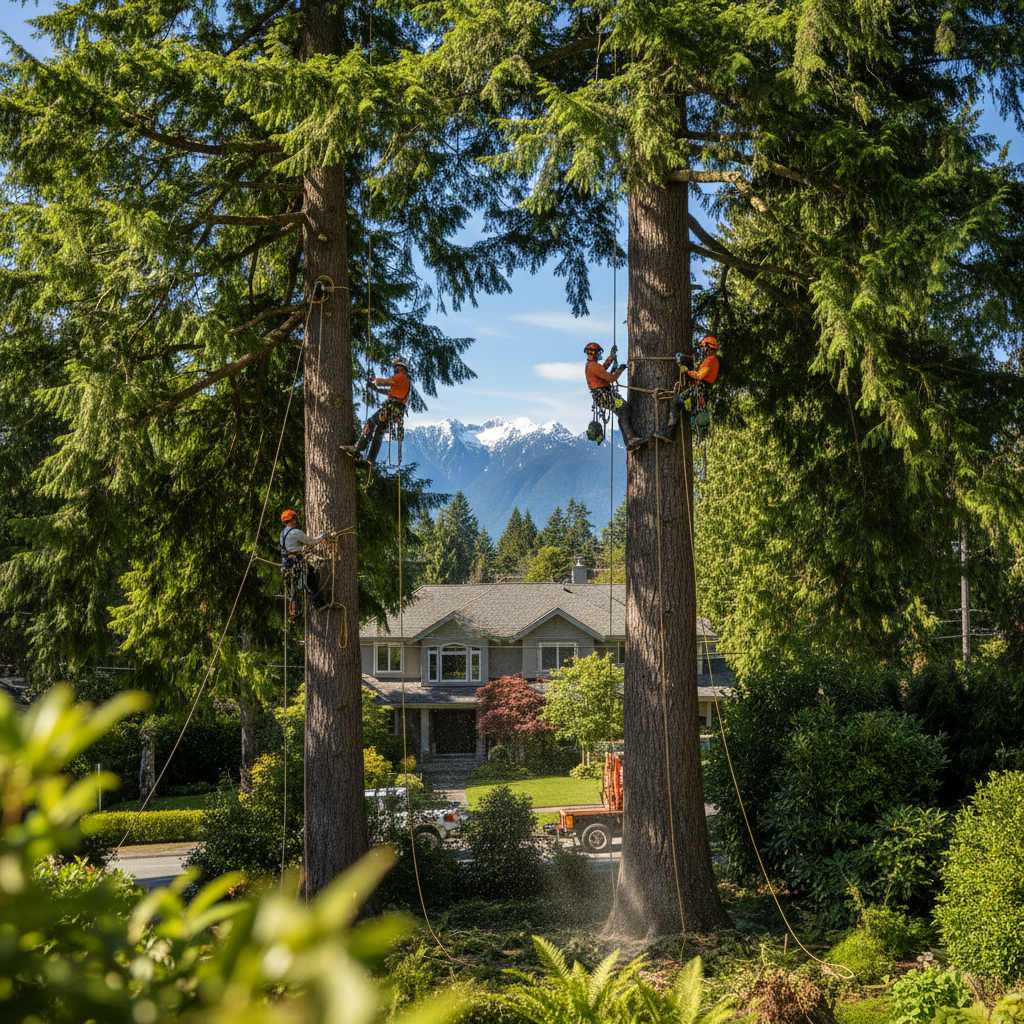
Aesthetic Tree & Hedge Services works across Vancouver, Burnaby, North Vancouver, Richmond, Coquitlam, and nearby Lower Mainland communities. We see the same pattern often. Homeowners wait until a tree becomes urgent. Then a cracked limb, blocked driveway, failed hedge, or permit issue turns into stress.
This guide helps you spot the work that matters before that happens.
TL;DR
- Vancouver tree care is safety work first. Health, structure, clearance, and permits all matter.
- The City of Vancouver says private trees 20 cm or larger in diameter, measured 1.4 m above ground, need a removal permit under Protection of Trees By-law 9958.
- Pruning should follow ANSI A300 standards. Topping is not professional pruning.
- Hedges need regular structure work, not random shearing, especially cedar, laurel, yew, and boxwood.
- Call Aesthetic Tree & Hedge Services for a free estimate at (604) 721-7370. Our team includes ISA-certified arborists and we are WCB registered.
Why Is Tree And Shrub Care Essential In Vancouver?
Tree and shrub care is essential in Vancouver because our urban forest works hard. It shades homes. It slows rain. It protects soil. It also carries real risk when it is poorly managed.
The City of Vancouver's 2025 Urban Forest Strategy says Vancouver has about 150,000 street trees, 36,000 specimen trees in parks and golf courses, and more than 1 million trees across 444 hectares of public forests and woodlands. That is a lot of living structure in a tight city.
The same strategy says Vancouver's canopy cover reached about 25% in 2022. That was up from 23% in 2018 and 21% in 2013. The city target is 30% by 2050.
That progress is good news. But it does not mean every tree on every property is safe. A city can gain canopy while individual trees decline. We see this often after drought, construction, root cutting, topping, or storm damage.
Metro Vancouver's 2024 tree canopy reporting also shows pressure at the regional level. Its Metro 2050 performance measure says tree canopy within the Urban Containment Boundary fell from 32% in 2014 to 31% in 2020. The regional target is 40% by 2050.
That one-point drop sounds small. It is not small. Across a region, one percent is a large amount of shade, rainfall capture, and habitat.
For homeowners, the lesson is plain. Keep good trees healthy. Remove hazardous trees properly. Plant the right species in the right place. And maintain hedges before they become heavy, open, or unstable.
If you already know a tree has to come down, start with professional tree removal in Vancouver. A certified assessment can save time, reduce risk, and help with permit steps.
When Do You Need A Tree Removal Permit In Vancouver?
You need a tree removal permit in Vancouver when the tree is on private property and has a diameter of 20 cm or greater, measured 1.4 m above the ground. That rule comes from the City of Vancouver's Protection of Trees By-law 9958.
The city also notes that a 20 cm diameter tree has a circumference of about 64 cm. That helps homeowners measure it with a tape.
Here is the practical version.
Measure the trunk at chest height, 1.4 m from the ground. If the trunk is 20 cm wide or more, assume a permit is required before removal. If the tree is smaller, do not assume it is exempt. Replacement trees, development landscape trees, and trees tied to earlier permits can still carry restrictions.
Vancouver may allow removal when specific conditions apply. Examples include a dead, dying, or hazardous tree. The city may also consider trees in a building envelope, trees that interfere with utility wires and cannot be pruned while staying healthy, or roots that directly block sewer or drainage systems when certified by the right professional.
Development adds another layer. If a property has trees 20 cm or larger, an arborist report is required for a development permit application. Retained trees also need protection during construction.
This is where many homeowners get stuck. They think the question is, Can I cut this down? The better question is, What does the bylaw require, and what does the tree condition show?
An ISA-certified arborist can inspect structure, decay, root zone damage, lean, canopy dieback, species, target risk, and site conditions. If removal is needed, the report gives the city useful evidence.
For development, insurance, neighbour disputes, or permit files, use a formal arborist report in Vancouver. It gives clear documentation, not guesswork.
Rules also change by city. Richmond's Tree Protection Bylaw No. 8057 generally requires a permit for trees 20 cm or larger at breast height. Richmond also says topping is prohibited on private and city trees, with fines up to $50,000 per tree. Burnaby, North Vancouver, Coquitlam, and other Lower Mainland cities have their own rules.
The safest habit is simple. Check the local bylaw before cutting.
How Do You Know If A Tree Is Hazardous?
A hazardous tree is not always obvious. Some dangerous trees look green. Some ugly trees are stable. The key is structure, not appearance.
Start with the base. Look for root flare. The root flare is where the trunk widens into the roots. It should be visible. If soil, mulch, or fill covers it, decay can hide there. If the tree rocks at the base in wind, call an arborist.
Next, look at the trunk. Deep cracks, open cavities, fungal conks, fresh splits, and peeling bark can signal internal decay. A vertical crack after wind is urgent. So is a tree that suddenly leans.
Then check the canopy. Dead limbs, broken hangers, sparse leaves, and heavy end-weighted branches deserve attention. On mature maples and cedars, long limbs can fail when weight sits too far from the trunk.
Pay attention to targets. A tree in the back corner of a large property is one kind of risk. A tree over a bedroom, driveway, sidewalk, greenhouse, or service line is another. Risk depends on both tree condition and what the tree can hit.
Species matters too. Western red cedar, Douglas fir, hemlock, birch, cherry, poplar, and Big-leaf maple all fail in different ways. A cedar hedge can split under snow. A birch can decline fast after drought. A maple can hide decay in large unions. A poplar can drop limbs even when it looks vigorous.
The City of Vancouver's Stanley Park forest management page shows how fast forest health can turn into safety work. It reports that 160,000 of about 600,000 trees in Stanley Park were dead or dying after hemlock looper damage. That is a park-scale example, but the lesson applies at home. Dead standing wood does not stay predictable.
Homeowners do not need to diagnose everything. But they should know when to stop guessing.
Call for a hazard assessment when you see:
- A new lean or soil lifting near roots
- Dead branches over a target
- Cracks, cavities, or fungal growth on the trunk
- Storm-damaged limbs hanging in the canopy
- A tree touching service lines or structures
- Recent trenching, paving, or grade changes near roots
- Sudden dieback after drought or construction
If a tree has failed, is hung up, or threatens a building, use emergency tree service. Do not stand under it. Do not pull it with a truck. Do not cut tension wood unless you are trained.
What Is The Right Way To Prune Trees In Vancouver?
The right way to prune trees in Vancouver is to set a clear objective first. Then make cuts that protect health and structure.
Good pruning is not just making a tree smaller. In fact, making a tree smaller the wrong way creates more risk.
Professional pruning follows ANSI A300 standards. The Tree Care Industry Association describes ANSI A300 as standards for tree care practices and specification writing. The International Society of Arboriculture also publishes the 2023 ANSI A300 Tree Care Standards, including pruning guidance.
That matters because pruning is surgery. Every cut is a wound. A good cut gives the tree a fair chance to seal. A bad cut creates decay, weak sprouts, and future failure points.
In our work, pruning usually falls into a few clear goals.
Deadwood pruning removes dead, dying, or broken branches. This reduces hazards and improves appearance without overcutting live tissue.
Clearance pruning gives space from roofs, gutters, walkways, driveways, lights, signs, and service lines. The goal is clearance without stripping the tree.
Structural pruning improves branch spacing, reduces included bark, and trains young trees. This is often the best value in tree care because early work prevents large failures later.
Crown reduction reduces height or spread using proper reduction cuts. This is different from topping. A reduction cut goes back to a suitable lateral branch. Topping cuts through stems at random points and leaves weak regrowth.
Crown cleaning removes select problem branches. It does not gut the canopy.
Avoid lion-tailing. That is when inner branches are stripped out and foliage stays only at branch ends. It looks tidy for a week. Then wind load increases, sunscald risk rises, and branch failure becomes more likely.
Avoid topping. Topping does not make a tree safe. It shocks the tree, invites decay, and creates fast-growing sprouts with weak attachments. Richmond's tree bylaw bulletin specifically says topping is prohibited. Many professional arborists treat topping as a red flag.
Timing matters too. Many trees can be pruned in late winter or during dormancy. Some pruning is fine in summer when the goal is to slow growth or remove weight. Storm damage should be addressed when it happens. Flowering shrubs and hedges have their own timing.
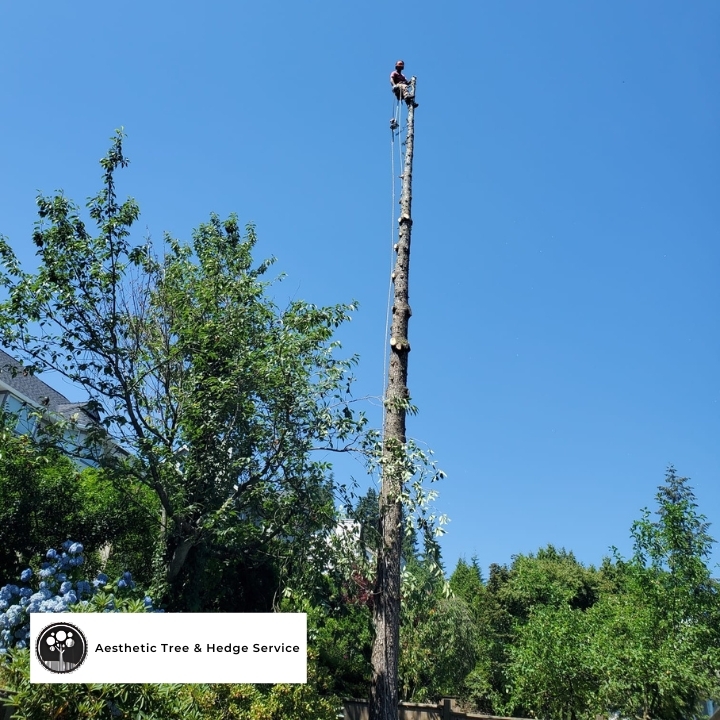
For larger pruning, clearance work, or controlled cutting, use professional tree cutting in Vancouver. The goal is not just to cut. The goal is to cut correctly.
How Should Vancouver Homeowners Care For Hedges And Shrubs?
Vancouver homeowners should care for hedges and shrubs by building structure first. Shape comes second.
A hedge is not a wall. It is a row of woody plants trying to grow like trees or shrubs. If you shear only the outer shell, the inside gets shaded. Then it turns brown and bare. Once cedar or cypress wood goes dead inside, it often does not refill.
Cedar hedges need steady, careful trimming. The sides should taper slightly, wider at the base and narrower at the top. That lets light reach lower foliage. A top-heavy hedge blocks light and catches snow.
Laurel hedges need selective cuts more than hard shearing. Big leaves look shredded after hedge trimmers. Hand cuts often give a cleaner result.
Yew responds well to pruning, but it still needs planning. Boxwood needs airflow and sharp tools because disease spreads through dense, damp growth.
Timing matters. Spring growth, nesting season, summer drought, and fall recovery all affect hedge work. In Vancouver, we also watch heat. Trimming during hot dry spells can burn exposed foliage.
The most common hedge mistake is waiting too long. A hedge that grows one metre too tall is not always easy to bring back. Hard cuts into bare cedar create permanent holes. Heavy reductions can also open privacy gaps.
A better plan is regular, measured work. Trim enough to control size. Leave enough green growth to support the plant. Keep the top narrow enough for light and snow shedding. Clear the base so moisture does not sit against trunks.
Shrubs need the same respect. Rhododendron, hydrangea, pieris, Japanese maple, lilac, and camellia all respond differently. One shearing style does not fit them all.
For privacy hedges, boundary hedges, view corridors, and tall cedar rows, book hedge trimming services in Vancouver. Good hedge work is slow enough to protect the plant and efficient enough to keep the property clean.
What Should You Do After Removing A Tree Or Stump?
After removing a tree, deal with the stump, roots, soil, and replacement plan. The job is not finished when the trunk is gone.
A stump can create several problems. It can trip people. It can block replanting. It can attract decay fungi and insects. It can also keep sending shoots, depending on species.
Stump grinding removes the visible stump by grinding it below grade. The remaining chips can often be used as mulch, depending on site needs and tree condition. The depth depends on what comes next. A lawn needs one approach. A new tree, patio, fence, or driveway needs another.
In Vancouver, roots often sit close to utilities, irrigation, fences, retaining walls, sidewalks, and old drainage lines. That means stump work should be controlled. Grinding is not just pushing a machine forward. It needs site awareness.
After grinding, inspect the soil. If you plan to replant, do not drop a new tree into compacted sawdust and hope. Wood chips tie up nitrogen as they break down. Soil may need removal, amendment, or rest.
Species choice matters. A replacement tree should fit the space at mature size. Do not plant a large conifer under service lines. Do not plant an aggressive-rooted species beside old drains. Do not plant a wide canopy tree in a narrow side yard.
Metro Vancouver's climate adaptation work points to future pressure from drier summers and changing soil moisture. That matters for planting. A species that did fine twenty years ago may struggle on a paved, hot, south-facing lot now.
The City of Vancouver says it selects new public trees based on future climate projections, existing diversity, and site suitability. Homeowners should use the same logic.
For tight sites, access limits, or follow-up planting plans, pair removal with stump grinding in Vancouver. If you are replacing canopy, ask about tree planting too.
How Do Storms, Heat, And Drought Change Tree Risk In The Lower Mainland?
Storms, heat, and drought change tree risk by weakening roots, drying soil, and loading branches in ways homeowners do not always see.
Vancouver gets wet winters. That can saturate soil. Saturated soil holds roots less firmly, especially on slopes or near recent excavation. Then wind arrives. A tree with root loss can fail even if the canopy looks full.
Dry summers create a different issue. Drought stress can kill fine roots. It can also make trees more open to pests and disease. The damage may not show until months later.
BC Hydro warned in 2023 that drought-weakened trees and branches were expected to contribute to storm-season power outages. That is the same risk homeowners see on a smaller scale. Dead limbs do not always fall during the dry period. They fall when wind and rain return.
Heat also matters. The BC Coroners Service reported 619 heat-related deaths during the 2021 heat dome. That statistic is about public health, not arboriculture. But trees are part of the local heat response. Shade lowers surface temperatures, protects soil moisture, and makes yards and sidewalks more usable.
The City of Vancouver says low-canopy areas such as the Downtown Eastside and Marpole experience extreme heat more intensely. That is why canopy is not just scenery. It is protection.
For private properties, the response is practical.
Water young trees during dry periods. Water slowly, near the root zone, not against the trunk. Keep mulch off the bark and away from the root flare. Inspect after wind. Clear deadwood before storm season. Reduce end weight on overextended limbs with proper cuts. Do not top trees to prepare for wind. Topping creates weaker regrowth.
If a tree is near power lines, do not prune it yourself. Contact the utility or an arborist trained for the situation. Electricity changes the whole job.
WorkSafeBC's 2022 safety campaign reported that manual tree falling in B.C. had an injury rate of 20.1 in 2020, nearly ten times the provincial average of 2.15. The serious injury rate was 6.5, compared with the provincial average of 0.27. That is why WCB registration, training, rigging, saw control, and site planning matter.
Tree work looks simple from the ground. It is not simple in the tree.
Which Tree And Shrub Jobs Should You Never DIY?
Do not DIY tree or shrub work when height, weight, tension, electricity, decay, permits, or property damage are involved.
Small hand pruning from the ground is fine for many homeowners. Removing a dead twig from a young ornamental tree is not the same as cutting a loaded limb over a garage.
Leave these jobs to trained crews:
- Tree removal near homes, fences, sheds, or wires
- Large limb removal over targets
- Storm-damaged trees under tension
- Trees with cracks, cavities, or root plate movement
- Any chainsaw work on a ladder
- Any work near service lines
- Tall cedar hedge reductions
- Stump grinding near utilities or hardscape
- Permit-related removal
- Crane or rigging removals
Chainsaws and ladders are a bad pairing. So are pickup trucks and ropes tied to trees. Pulling a tree changes force fast. The tree can barber-chair, split, swing, or pull the vehicle.
Professional crews plan the drop zone, rigging points, escape routes, communication, traffic, pedestrian control, and cleanup. They also know when a job needs a bucket truck, crane, climber, lowering system, or staged removal.
On tight Vancouver lots, controlled removal is often the real skill. A tree may sit between a laneway house, glass railings, a cedar hedge, and overhead wires. There is no room for error.
For trees too large or tight for standard removal, ask about crane tree removal. A crane can reduce impact when the site demands it.
For slopes, acreage, development prep, or multiple removals, land clearing may be the right service. But clearing still needs bylaw review and tree protection planning.
How Do Arborists Decide Between Pruning, Cabling, Root Barriers, And Removal?
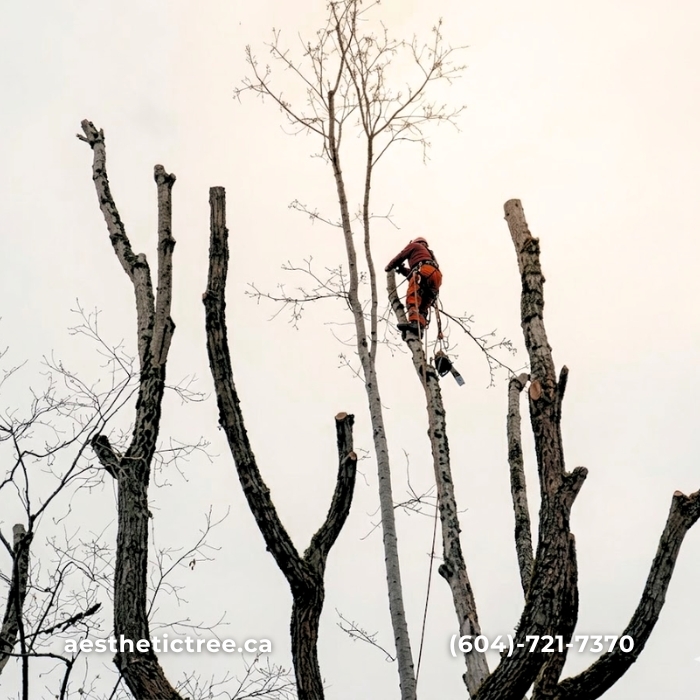
Arborists decide by looking at risk, tree value, species response, site use, and long-term outcomes. The best answer is not always removal. It is also not always preservation.
A healthy tree with poor branch structure may need pruning. A valuable tree with a weak union may need cabling. A tree lifting hardscape may need a root barrier, if the site allows it. A dead or high-risk tree over a home may need removal.
The first step is inspection. We look at root flare, trunk condition, scaffold limbs, canopy density, deadwood, lean, soil, drainage, construction history, and targets.
Then we ask what the owner needs. More light? Safer parking? Better clearance? Privacy? Permit support? Construction access? Each goal points to a different scope.
Cabling can help reduce movement in a weak union or heavy limb system. It does not make a bad tree good. It supports a specific structural issue when the tree is worth retaining and the risk is manageable.
Root barriers can help manage root conflicts near hardscape or services. They are not magic. Installed poorly, they damage the roots needed to keep a tree stable. Installed correctly, they can guide future root growth and protect nearby infrastructure.
Mulching helps soil moisture and root health. But mulch should be wide and shallow, not piled against the trunk. A mulch volcano traps moisture against bark and invites decay.
Removal is the right choice when risk is high, decline is advanced, or site conflict cannot be solved responsibly. In those cases, delaying removal raises risk and often raises cleanup complexity.
Useful support services include tree cabling, root barrier installation, and mulching. The right choice depends on the tree, not on a one-size plan.
What Should A Vancouver Tree Care Visit Include?
A Vancouver tree care visit should include a site review, clear scope, safety planning, cleanup expectations, and bylaw awareness.
Start with the concern. Maybe the cedar hedge is too tall. Maybe a maple branch is over the roof. Maybe a fir moved in the last windstorm. Maybe a neighbour asked about a shared boundary tree.
A good arborist listens first. Then they inspect.
For trees, that means structure, roots, trunk, canopy, targets, access, and species. For hedges, it means height, width, density, light, dead zones, property lines, and recovery potential. For stumps, it means utilities, access width, slope, and what will happen after grinding.
You should get plain language. Not scare tactics. Not vague promises. The scope should say what work is being done and why.
For pruning, ask what the objective is. Deadwood? Clearance? Structure? Reduction? If someone says they will top the tree, stop the conversation.
For removal, ask about permits. Ask about rigging. Ask where debris goes. Ask whether stump grinding is included. Ask how fences, lawns, gardens, and neighbouring property will be protected.
For hedges, ask how much green growth will remain. This is especially important with cedar. Cutting past green foliage can leave brown patches that do not recover.
For reports, ask whether the arborist is ISA-certified and whether the report meets the municipality's needs.
For any crew, ask about WCB registration and insurance. This is not paperwork for its own sake. It protects workers and property owners.
Aesthetic Tree & Hedge Services brings that safety-first approach to residential and commercial sites across Vancouver and the Lower Mainland. Our work is practical. We care about trees, but we care about people under them too.
How Can You Build A Simple Annual Tree And Shrub Care Plan?
You can build a simple annual tree and shrub care plan by matching work to seasons. Vancouver's climate gives us a useful rhythm.
In late winter, inspect structure. This is a good time for many pruning jobs because branches are easier to see. It is also a smart time to plan removals before spring growth hides defects.
In spring, watch for new growth, pests, and hedge shape. Do not rush heavy pruning during nesting activity. Do water new plantings if dry weather arrives early.
In summer, protect young trees from drought stress. Water deeply. Keep mulch wide and shallow. Avoid heavy pruning during heat waves unless safety requires it.
In early fall, prepare for storm season. Remove deadwood over targets. Check trees near roofs, driveways, and play areas. Trim hedges so they do not catch snow or block walkways.
In winter, respond to storm damage quickly. Broken limbs and partial failures can change tension inside the tree. That is not a DIY moment.
A simple homeowner checklist looks like this:
- Inspect trees after major wind
- Keep root flares visible
- Water young trees during drought
- Mulch correctly, with no bark contact
- Prune with a goal, not a guess
- Trim hedges before they outgrow recovery limits
- Check bylaws before removal
- Use ISA-certified arborists for risk, permits, and large work
For deeper reading, Aesthetic Tree also has guides on seasonal tree care, tree removal in Vancouver, and understanding arborists.
The big idea is this: do not wait for a branch on the ground to start caring for the tree above it.
FAQ
What is the most important tree care task for Vancouver homeowners?
The most important task is regular inspection. Look at the root flare, trunk, canopy, and nearby targets. Vancouver's wind, rain, drought, and dense lots make small defects matter. If you see cracks, fresh lean, dead limbs, fungal growth, or root movement, book an arborist assessment.
Do I need a permit to remove a tree on private property in Vancouver?
Yes, if the tree is 20 cm or larger in diameter, measured 1.4 m above the ground. That rule comes from the City of Vancouver Protection of Trees By-law 9958. Smaller trees can still have restrictions if they were replacement trees or tied to development plans. Check before cutting.
Is topping a tree ever a good idea?
No. Topping is not proper pruning. It creates decay points and weak regrowth. It can make a tree more hazardous over time. Professional pruning should follow ANSI A300 standards and use cuts that match a clear objective.
How often should cedar hedges be trimmed in Vancouver?
Most cedar hedges do best with regular trimming once or twice per year, depending on growth, site, and desired shape. The key is to keep green foliage and avoid hard cuts into bare wood. A slightly tapered shape helps lower branches get light.
When should I call an emergency tree service?
Call emergency tree service when a tree or limb has failed, is hanging, is leaning toward a structure, is blocking access, or is near wires. Keep people away from the area. Do not cut storm-damaged wood under tension yourself.
Tree and shrub care is not about making a yard look tidy for one weekend. It is about keeping living structures healthy, safe, and suited to the property around them. If you need pruning, removal, hedge trimming, stump grinding, or a permit-ready arborist report, call Aesthetic Tree & Hedge Services for a free estimate at (604) 721-7370. Our team includes ISA-certified arborists, and we are WCB registered.
Found this helpful? Follow our tree care insights directly on Google.
Make us your preferred source on GoogleBefore You Go
Where are you in your tree care journey?
Our Tree Care Services
ISA-certified arborists serving Greater Vancouver


Explore Our Tree Care Services
From expert pruning to safe tree removal, our ISA-certified arborists are ready to help across Greater Vancouver.
View Services