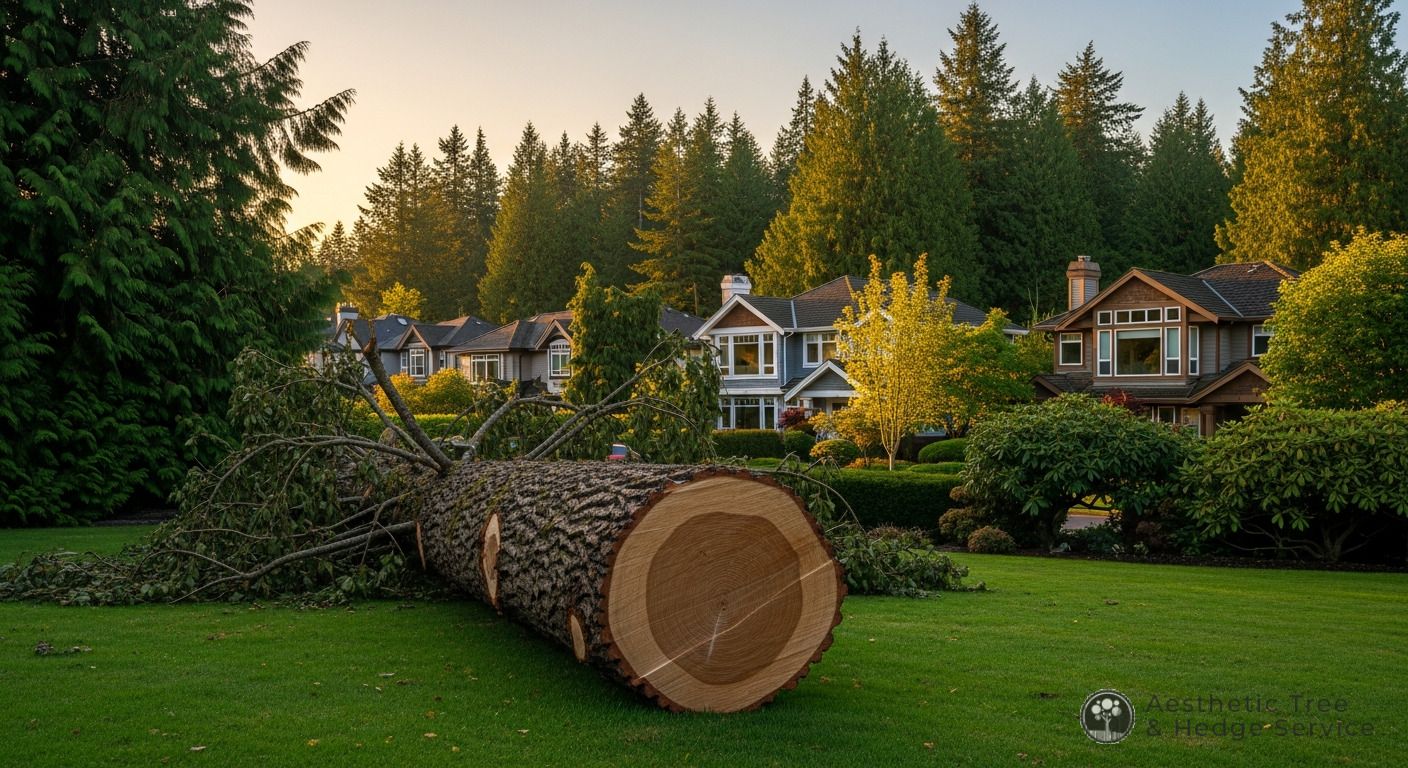

TL;DR — Quick Summary
Tree removal Coquitlam: when you need a City permit, and when you don't. ISA-certified arborists explain 5 bylaw facts before you cut. (604) 721-7370.
- Coquitlam's Tree Management Bylaw No. 4091 protects trees 20 cm or more in diameter at 1.4 m, but most homeowners can remove up to two of them in a 12-month period without a permit.
- A permit is needed for a third protected tree in 12 months, or for any removal near a stream, on a steep slope, under a protective covenant, or on Burian Drive or Latimer Avenue.
- Topping or pollarding a tree counts as damage under the bylaw, and the homeowner may be fined.
- If a tree straddles the property line, the City needs written consent from both owners.
- The City requires a tree risk assessment report from an ISA Certified Arborist for trees near a watercourse, in a vegetation covenant area, or on Burian Drive or Latimer Avenue.
In Coquitlam, the permit question comes down to three things: the tree's diameter, how many protected trees you have removed in the past 12 months, and whether the property sits in a sensitive area.
The rules come from the City of Coquitlam's Tree Management Bylaw No. 4091, 2010, which applies to all private properties in the city.
Here are the facts that matter.
Does Tree Removal in Coquitlam Require a Permit?
Sometimes. It depends on the tree's size, how many you remove, and where the tree is.
Under the City of Coquitlam's Tree Management Bylaw, a protected tree is one that is 20 cm or more in diameter measured 1.4 m from the ground, a replacement tree, or a tree planted as a requirement of development. In most cases, private property owners may remove up to two trees of protected size per year without a permit. Removing more than two protected trees in a 12-month period requires a Tree Cutting Permit, and so does removing a replacement tree.
A permit is always required, whatever the count, if the tree is in a riparian area or Streamside Protection and Enhancement Area (SPEA), on a steep slope (over 36%), in an area with a protective covenant, or on Burian Drive or Latimer Avenue. Proper pruning does not need a permit.
The two-tree allowance is easy to lose track of. Count every protected tree removed in the past 12 months before you plan another.
If you're not sure whether your tree needs permission, talk to an ISA-certified arborist before you call a removal crew. Our team creates arborist reports that document the species, size, and condition of the tree, which is the information the City asks for when a report is required.
Which Trees Are Protected Under Coquitlam's Tree Bylaw?
Coquitlam's bylaw protects trees in three ways.
Size-protected trees are 20 cm or more in diameter, measured 1.4 m from the ground. The size test applies whatever the species.
Replacement and development trees are protected at any size. A tree planted as a replacement under a permit, or as a requirement of development, needs a permit to remove.
Location is the third test: trees on a steep slope or in a streamside protection area need a permit no matter how many trees you have removed. Species still matters for another reason: understanding how the tree might fail. Each species fails in different ways. Big-leaf maple grows large side branches prone to breaking under wet snow — the tree can look healthy while carrying hidden decay inside. Western red cedar develops heartwood rot you can't see from outside, but arborists can detect it with specialized drilling or sonic imaging.
Knowing the species is the first step in any proper hazard assessment. It tells an arborist where to look for problems.
What Is the Fine for Removing a Tree Without a Permit in Coquitlam?
Coquitlam treats topping and other damage to a protected tree as a ticketable offence. For current fine amounts, ask the City's Urban Forestry team (604-927-3482) before any work starts.
First: bylaw fines. Coquitlam's tree FAQ says improper pruning such as topping or pollarding is damage, and the homeowner may be subject to fines. Confirm permit requirements yourself before any work starts, even if a contractor says none are needed.
Second: replacement trees. When a permit is issued, replacement trees may be a condition. Whether you need them depends mainly on your lot size and how many protected trees remain after removal. Replacement trees are bonded at $300 each, and 90% of the bond is returned once they are planted and pass inspection. Hedge species, shrubs, and dwarf varieties are not accepted as replacements.
When Is Tree Removal in Coquitlam Exempt from the Permit Requirement?
Coquitlam's rules are more flexible than many homeowners expect, but the limits are strict.
The two-tree allowance. Outside sensitive areas, you may remove up to two trees of protected size in a 12-month period without a permit. A third tree in that period needs a permit.
Keep a record of the dates of any protected trees you remove, so you know where you stand before the next one.
Slopes are different. Coquitlam says trees on a steep slope cannot be removed unless an ISA certified arborist deems them hazardous, because their roots can be integral to slope stability.
Trees under 20 cm. A tree with a trunk under 20 cm in diameter at 1.4 m does not need a permit, unless it is a replacement tree or sits on a slope or in a protected riparian area. Measure before you assume.
Pruning. Proper pruning does not need a permit. Topping or pollarding is treated as damage, and the homeowner may be fined.
Trees near power lines. Do not prune near lines yourself. BC Hydro advises staying 3 to 6 metres away from power lines depending on voltage, and asks you to call 1 800 224 9376 about a tree near a power line.
For genuine emergencies — a tree on your roof tonight, a hanging branch over a public path after a storm — our emergency tree service responds 24/7 to assess the hazard and make the site safe.
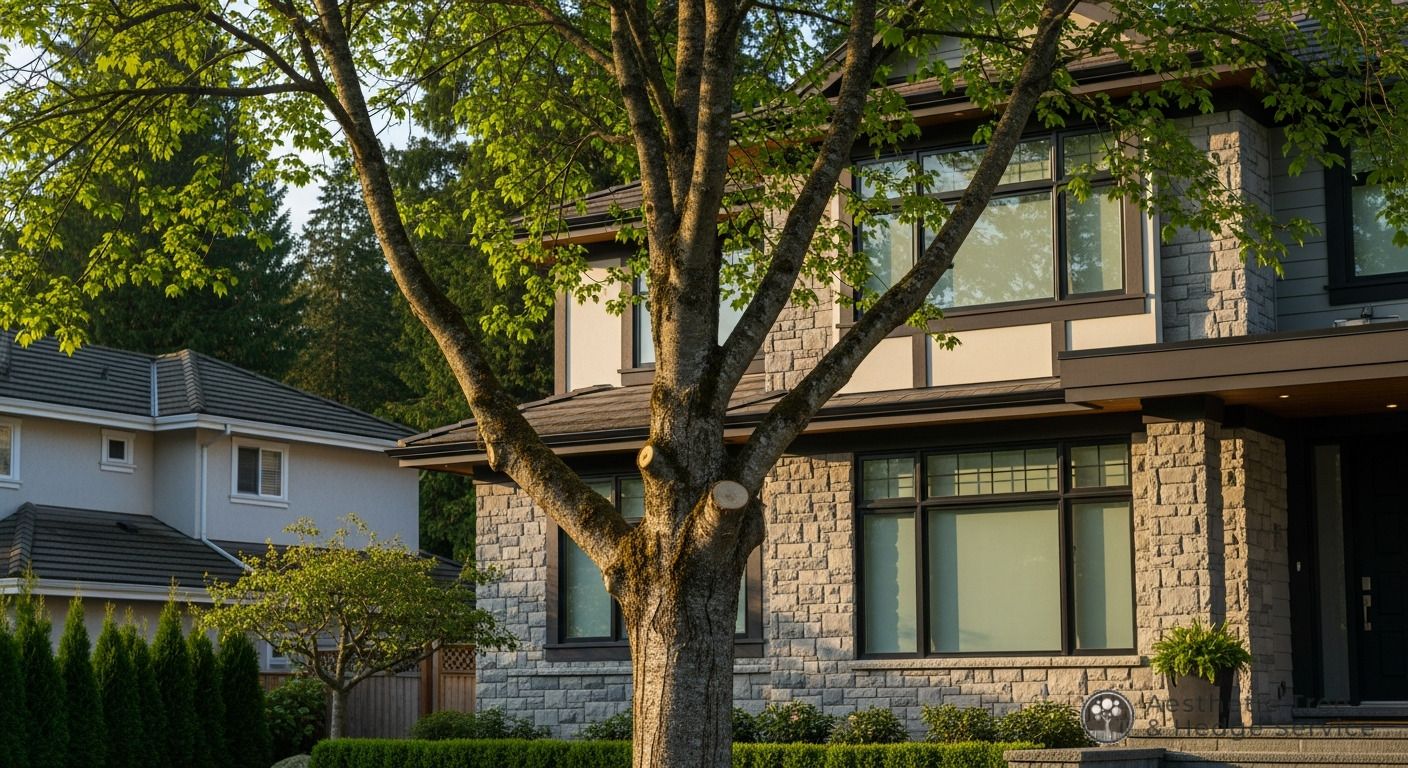
How Do You Know When a Tree Actually Needs to Come Down?
Homeowners make removal decisions based on fear or how the tree looks. ISA-certified arborists make decisions based on structural evidence.
A structured assessment looks for these warning signs.
1. Lean and root plate movement. Visible soil heaving on one side of a leaning tree can signal root plate movement. Not all lean is dangerous — many trees grow at an angle safely — but lean paired with recent root movement is serious.
2. Crown dieback. Dead branches in the upper crown signal root stress, vascular disease, or soil compaction. Dieback alone doesn't mean removal. It means assessment.
3. Included bark at co-dominant stems. A tight "V" union between two stems of nearly equal size, with bark embedded inside the union rather than a visible ridge, creates a weak attachment. These split under high wind and wet snow.
4. Cavities and fungal indicators. Open cavities reduce the structural material available to hold weight. Shelf fungi on the trunk, or mushrooms at the base, can signal wood decay. Coquitlam's tree FAQ lists cracks in the trunk and mushrooms at the base as possible signs of decline. These are not cosmetic issues. They are structural ones.
5. Critical root zone damage. Construction, soil compaction, trenching, or pavement near the tree's critical root zone (the area below the drip line) kills feeder roots. Crown decline can appear years later. Coquitlam warns that excavating within four metres of a tree may create a hazard. If excavation happened near your trees in recent years, get them assessed before symptoms show above ground.
6. Pest and disease load. Emerald ash borer is one example: the Canadian Food Inspection Agency describes it as an invasive beetle that attacks and kills all species of ash. Early detection can mean treatment instead of removal.
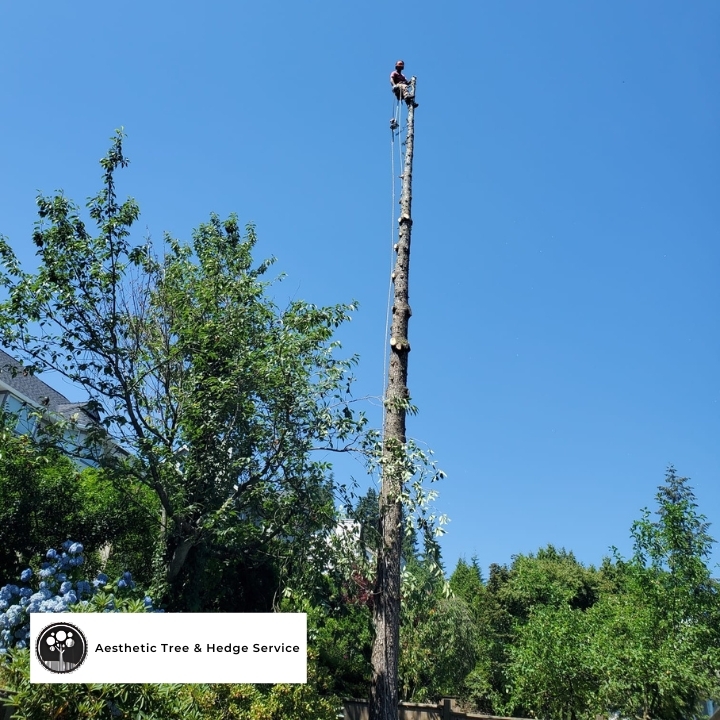
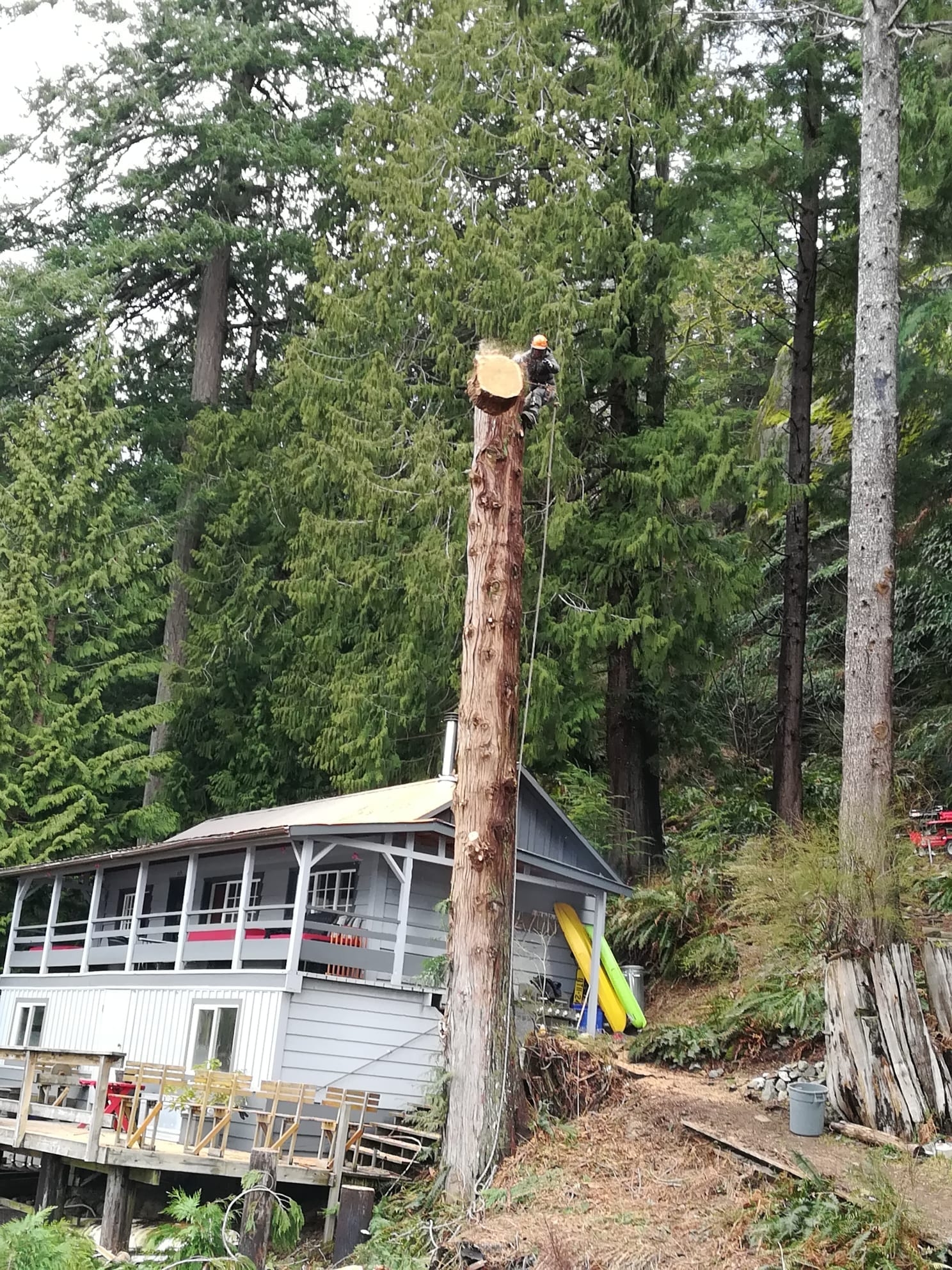
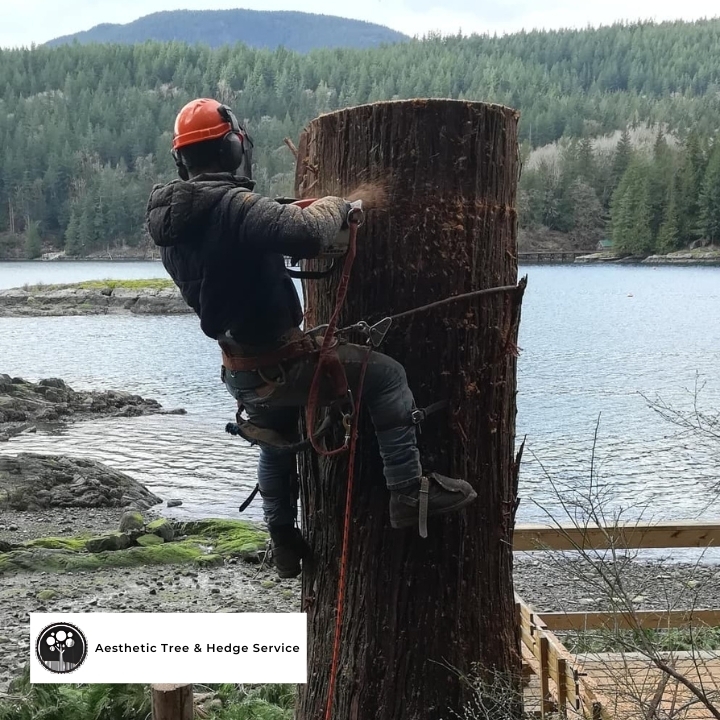
When a tree genuinely needs to come down, controlled rigging and directional felling — not freefall dropping near a structure — make the difference between a clean job and structural damage.
Our tree cutting service service handles removals that need controlled rigging close to structures.
Why Does Hiring an Uninsured Crew Expose You to Personal Liability?
This is the question homeowners stop asking when they see a low price.
WorkSafeBC says that if you hire a contractor who is not registered or not in good standing, you could be liable for the insurance premiums they owe. A clearance letter addressed to you, free and available online from WorkSafeBC, protects you from that.
Two credentials protect you:
WCB registration. WorkSafeBC registration means the contractor is enrolled in the provincial workers' compensation system. Ask for the contractor's WorkSafeBC details, then request your clearance letter before work starts.
ISA certification. The International Society of Arboriculture (ISA) certifies arborists and runs an online credential directory where you can check a name before hiring. Coquitlam's own tree FAQ recommends hiring an ISA certified arborist.
Ask for both WCB registration and ISA certification. A professional Coquitlam tree removal company provides them without hesitation.
What Happens After the Tree Comes Down?
A few decisions remain.
Stump removal. The stump won't disappear on its own. As it decays, it can attract insects and fungi, block replanting, and get in the way of new landscaping.
Stump grinding uses a rotating carbide-tipped wheel to reduce the stump to wood chips below ground. The resulting chips can stay as mulch or be removed. Stump grinding is quoted separately from tree removal in most cases — confirm whether it's included in any estimate before you sign.
Adjacent hedge and planting assessment. A removed tree changes the microclimate for everything around it. Cedar hedges that were shaded by an overhanging tree now face direct sun — sometimes for the first time in decades. Sunscald and dieback can follow once that shade is gone. Trees that provided windbreak for garden beds are gone. Neighboring plantings are now vulnerable.
Our hedge trimming service can assess adjacent hedges once their light and wind exposure has changed. Catching a problem early is easier than replacing dead hedging later.
Permit close-out. If your removal needed a permit, the valid permit must be on site while the work is done. If replacement trees were a condition, arrange a City inspection once they are planted so the bond can be returned.
What Should You Ask Before Hiring Any Coquitlam Tree Removal Company?
Here's the checklist. Ask all of these before anyone quotes you.
- "Are you WCB registered? What's your number?" — Then request a free clearance letter from WorkSafeBC.
- "Who on your crew holds ISA certification?" — Check the name in ISA's online credential directory.
- "Will you confirm whether this removal requires a City permit?" — A professional crew knows. An answer of "I'm not sure" is a red flag.
- "Do you carry adequate general liability insurance?" — Get the certificate in writing. Verbal assurance is not coverage.
- "What does your quote include — felling only, or stump grinding and debris removal too?" — Get it itemized.
- "Will you provide a written arborist assessment?" — This matters for permit applications, insurance documentation, and City file close-out.
- "What's your typical turnaround from permit approval to completion?" — Get the timeline in writing.
An ISA-certified, WCB-registered company answers all seven without hesitation. Coquitlam also requires the contractor doing the work to hold a valid business licence for Coquitlam or another Tri-Cities municipality. If you get pushback on any of them, call someone else.
Test Your Knowledge
1. Outside sensitive areas, how many protected-size trees can most Coquitlam homeowners remove in 12 months without a permit?
- ✅ A. Two
- B. None
- C. Five
- D. Unlimited
*Coquitlam's Tree Management Bylaw lets most private property owners remove up to two protected-size trees per 12-month period without a permit. A third tree, a replacement tree, or a tree in a sensitive area needs a permit.*
2. Which Coquitlam tree always needs a Tree Cutting Permit to remove?
- A. A 15 cm tree in a backyard with no sensitive areas
- ✅ B. A tree in a Streamside Protection and Enhancement Area
- C. The first protected tree removed this year on a flat lot with no covenant
- D. A tree you prune properly
*A Tree Cutting Permit is required for all tree removals on a property with a riparian area or Streamside Protection and Enhancement Area (SPEA), whatever the tree count.*
3. What does Coquitlam treat as damage to a tree, even without removing it?
Topping or pollarding. The City treats it as damage, and the homeowner may be fined.
4. How is a tree's diameter measured to determine whether it qualifies as protected under Coquitlam's bylaw?
The trunk diameter is measured 1.4 m from the ground. A tree 20 cm or more at that height is of protected size.
Frequently Asked Questions
Related: For more on this, see arborist port coquitlam: 7 checks before hiring.
Related: For more on this, see Arborist Report Cost in Vancouver: Why the Cheapest Report Often Gets Rejected.
Related: For more on this, see British Columbia Neighbour Tree Cutting Disputes: 4 Legal Realities Most Homeowners Miss.
Found this helpful? Follow our tree care insights directly on Google.
Make us your preferred source on GoogleBefore You Go
Where are you in your tree care journey?
Our Tree Care Services
ISA-certified arborists serving Greater Vancouver

Explore Our Tree Care Services
From expert pruning to safe tree removal, our ISA-certified arborists are ready to help across Greater Vancouver.
View Services