
TL;DR — Quick Summary
replanting after tree removal in Vancouver starts with permits, soil, species choice, and aftercare. Get arborist help before you plant.
replanting after tree removal sounds simple until the stump is gone, the soil is tired, and the city permit says a replacement tree is required.
Then the real question hits.
What should you plant?
Where should it go?
Will it survive?
And will your city approve it?
In Vancouver and across the Lower Mainland, replacing a tree is rarely just a landscaping choice. It can be a bylaw issue. A safety issue. A soil issue. A future root issue. It can also be the difference between a yard that recovers well and a yard that fights the new tree for years.
A removed Douglas fir, cedar, cherry, or Big-leaf maple leaves more than open sky. It leaves roots, decay, changed light, changed drainage, and a soil zone that needs care before a new tree goes in.
Aesthetic Tree & Hedge Services handles this work from the arborist side. That means we look at the removal reason first. Disease. Root conflict. Storm damage. Construction impact. Decline. Then we plan the replacement around the site, not just around the look of the tree.
TL;DR
- Don’t plant a new tree directly into an old stump hole without checking soil, roots, drainage, and decay first.
- Vancouver often requires replacement planting after permitted tree removal, especially for trees over 20 cm diameter.
- The best replacement tree depends on mature size, soil volume, sunlight, utilities, buildings, and municipal rules.
- Stump grinding helps, but it doesn’t create perfect planting soil by itself.
- Call Aesthetic Tree & Hedge Services before you plant. ISA-certified arborists can assess the site and help you avoid a costly replanting mistake.
Can You Replant a Tree in the Same Spot After Tree Removal?
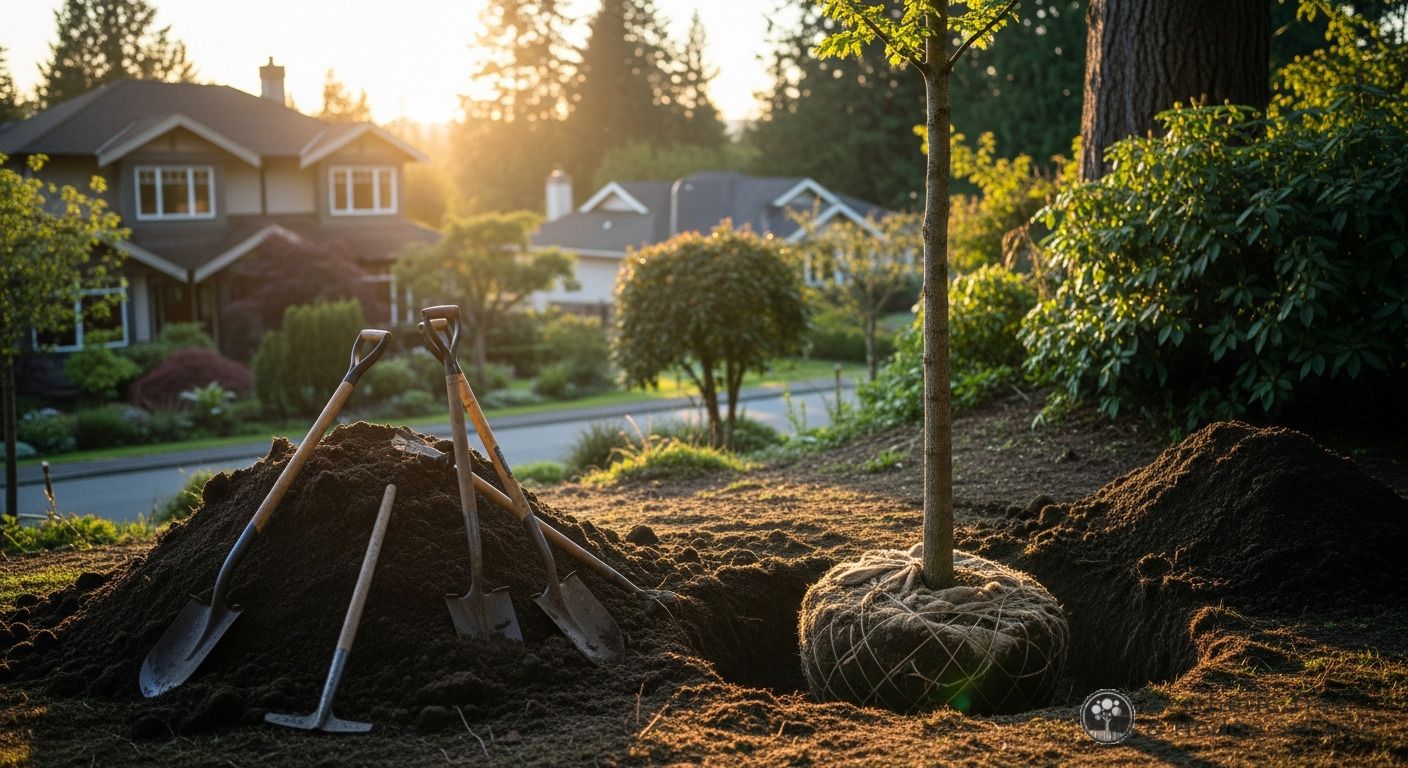
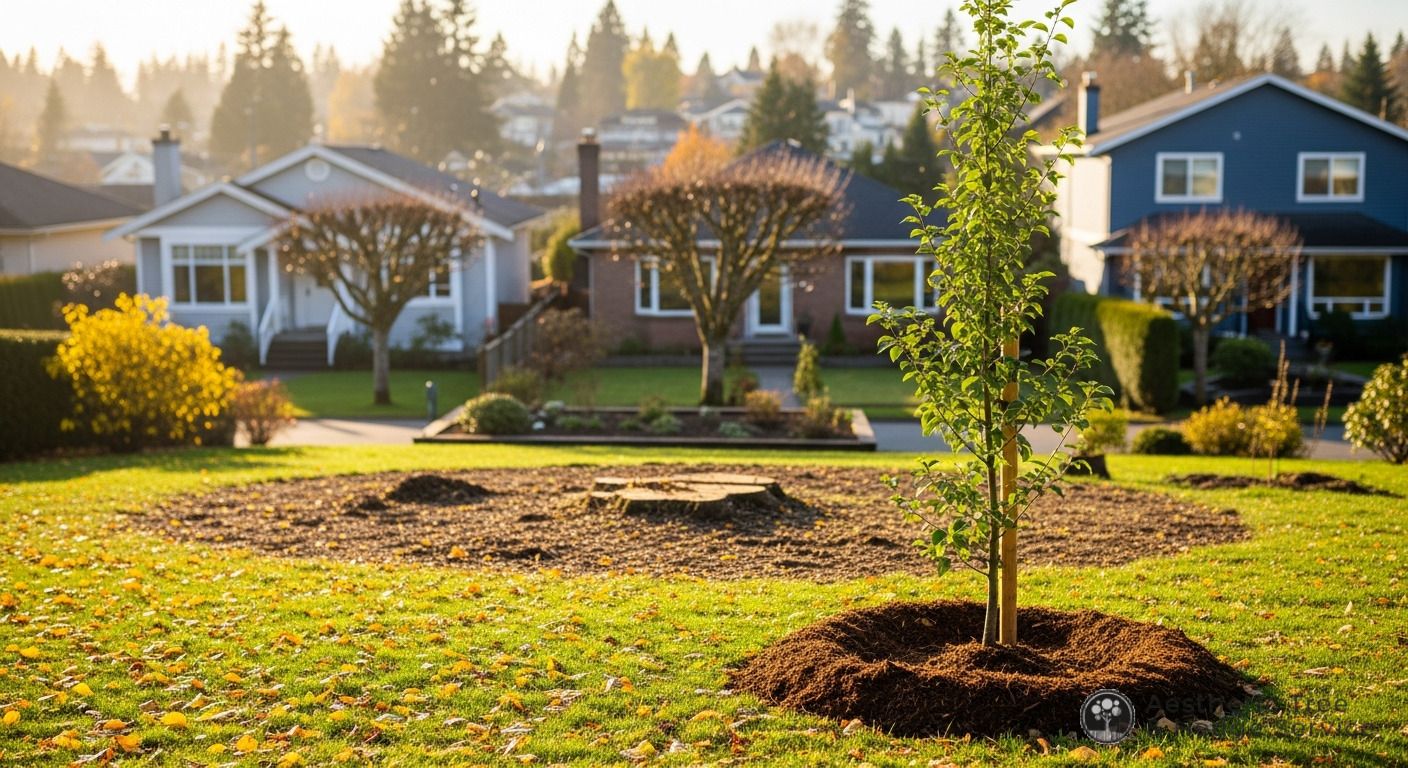
Yes, you can replant near the same spot after tree removal. But planting in the exact same hole is usually the wrong move.
The old root system is still there. Even after stump grinding, large woody roots stay in the soil. They decay over time. As they break down, the soil can settle. That creates air pockets, soft spots, and uneven moisture.
New roots don’t like that.
They need firm, living soil with oxygen, moisture, and enough open space to grow. A fresh tree planted into a pocket of wood chips and decaying roots often struggles. It may lean. It may dry out faster. It may yellow. It may fail after one hot summer.
In our experience, the better option is usually to shift the new tree a few feet away from the old trunk location. That gives the new root ball cleaner soil. It also reduces contact with old decay zones.
There are exceptions. Small ornamental trees can sometimes be planted near the old spot after soil work. But a large replacement tree needs more space. A Western red cedar, Douglas fir, Pacific dogwood, or Garry oak needs room for roots and canopy.
The old tree also changed the site while it was alive. Its canopy shaded the lawn. Its roots pulled water. Its needles or leaves changed the soil surface. Once it’s removed, the site gets more sun, more rain impact, and often more weeds.
That’s why replanting starts with a site check, not a nursery visit.
Do You Have to Replace a Tree After Removing One in Vancouver?
Often, yes.
The City of Vancouver’s Protection of Trees By-law requires a tree removal permit for many private trees. The City’s permit page states that a replacement tree is required for any removed tree larger than 20 cm diameter. Diameter is measured at 1.4 metres above grade.
That one rule surprises a lot of homeowners.
A tree can be yours. It can be in your yard. It can still fall under city rules.
Vancouver’s 2022 Tree Canopy Assessment, prepared by Diamond Head Consulting and released by the City in 2024, reported 25% canopy cover across the city. The same assessment measured 2,887 hectares of canopy. It also found that 37% of Vancouver’s canopy area sits on private property.
That’s why private replanting matters.
The city isn’t only counting park trees in Stanley Park, Queen Elizabeth Park, or Pacific Spirit Park. It’s also counting the cedar in your Kitsilano backyard, the maple in Mount Pleasant, and the ornamental plum in East Vancouver.
If your tree removal needs a permit, plan for replacement rules before the saws start. Aesthetic Tree can help with tree removal in Vancouver, then help you think through the replacement site.
Other municipalities have their own rules:
- Richmond’s Tree Protection Bylaw No. 8057 generally applies to trees over 20 cm DBH. The City of Richmond says fines can reach up to $50,000 per tree for topping or unlawful work.
- Burnaby’s tree replacement rules scale by tree size. As of its current guidance, a removed tree from 20.3 cm to 30.5 cm needs 1 replacement tree, 30.5 cm to 61 cm needs 2, and 61 cm or larger needs 3.
- Coquitlam’s Tree Management Bylaw 4091 protects living woody plants over 20 cm diameter, measured 1.4 metres from the ground. It also sets permit rules when more than two protected trees are removed in a 12-month period.
- The City of North Vancouver requires removal permits for regulated private trees and may hold a security deposit for required replacement planting.
Rules change. Properties vary. Development sites have extra requirements.
So don’t guess.
If the tree is protected, unsafe, near construction, or tied to a permit, get an arborist report before you replant.
How Long Should You Wait Before Replanting After Tree Removal?
You don’t always need to wait a full year. But you do need to wait until the site is ready.
That means the stump is handled. The major surface roots are assessed. The soil is corrected. The planting location is chosen. The season is right.
In the Lower Mainland, fall is often the best season for planting. Soil stays workable. Rain returns. Air temperatures drop. Roots can grow before summer stress arrives.
Spring can also work. But spring planting needs steady watering through the first summer. That matters more now than it did 20 years ago. Vancouver summers are hotter and drier. Young trees feel that stress first.
The wrong answer is planting the same day as removal just to “finish the job.”
That rush creates problems. The old stump grindings get mixed into the planting hole. The tree gets planted too deep. The root flare gets buried. The soil settles after the first rain. The tree starts its life under stress.
The ANSI A300 Part 6 planting standard says correct planting depth is based on locating the trunk flare and setting the bottom of that flare at finished grade. That standard matters. A buried root flare is one of the most common reasons young trees decline.
Here’s the simple test.
If the new tree looks like a telephone pole going straight into the ground, it’s too deep. You should see the root flare widen at the base.
Wait long enough to prepare the site right. That can mean days. It can mean weeks. On complex sites with drainage, construction, or disease concerns, it can mean longer.
What Should You Do With the Stump Before Planting a New Tree?
Deal with the stump before you plant. Don’t plant around it and hope roots sort it out.
A leftover stump takes up soil space. It can host decay fungi. It can send up shoots in some species. It can also block the best planting location.
Stump grinding is usually the practical choice for residential yards in Vancouver, Burnaby, Richmond, and North Vancouver. It grinds the stump below grade, removes the trip hazard, and opens the area for repair.
But grinding is not the same as soil building.
Fresh wood chips in the stump hole are not planting soil. They can hold water unevenly. They can also tie up nitrogen as they break down. That matters for a new tree with a small root system.
After grinding, we usually recommend removing excess grindings from the planting zone. Then backfill with suitable soil. Keep the new planting hole away from the densest old root mass when possible.
If the removed tree had root disease, the site needs more caution. Armillaria and other decay issues change what should be planted next. In those cases, species selection matters. So does spacing.
A clean-looking yard doesn’t mean a clean root zone.
That’s why an arborist looks below the surface. We check what was removed, why it failed, and what the new tree will face.
What Is the Best Tree to Plant After Removing an Old Tree?
The best replacement tree is the one that fits the site at maturity.
Not today.
At maturity.
That means height, spread, root pattern, water demand, shade tolerance, wind exposure, and bylaw approval all count.
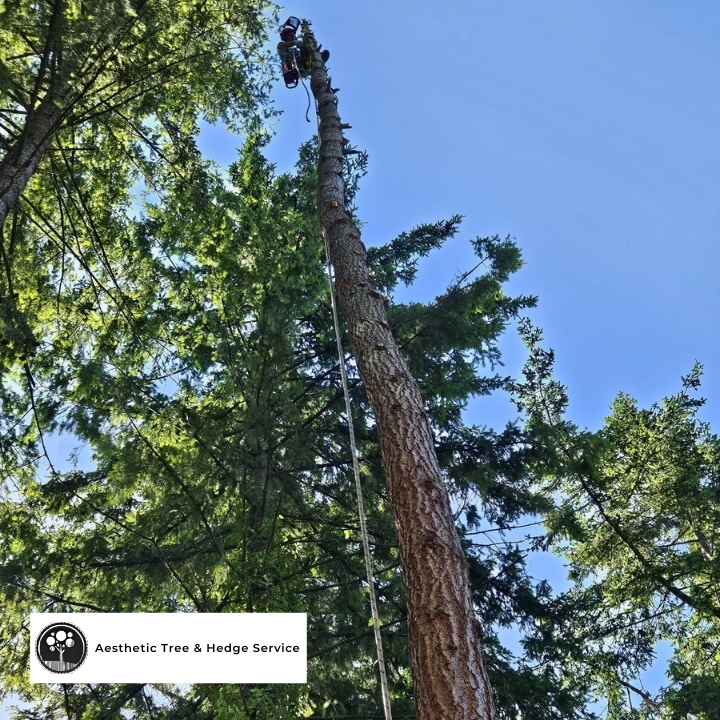
A small nursery tree can fool you. A young cedar looks tidy. A young maple looks harmless. A young Douglas fir looks like it belongs almost anywhere in the Lower Mainland.
Then it grows.
Near a house, fence, sewer line, sidewalk, retaining wall, or overhead service line, mature size matters. Planting too close creates the next removal job.
Good choices often include native or climate-suited species such as:
- Pacific dogwood for smaller ornamental spaces with the right conditions.
- Vine maple for filtered light and smaller yards.
- Shore pine for tough, open sites.
- Western red cedar where soil moisture and space support it.
- Garry oak in sunny, well-drained sites with enough room.
- Big-leaf maple only where there is serious space.
- Douglas fir only where mature height and wind exposure make sense.
For compact urban lots, the answer may be a smaller species. That’s not a downgrade. It’s good arboriculture.
The Metro Vancouver Urban Forest Climate Adaptation Initiative’s tree species work includes more than 300 species for local climate planning. That shows the real point. Species choice is not a guess. It’s a fit exercise.
Look at the site first:
- How much sun does it get after removal?
- Is the soil wet in winter?
- Does it bake in summer?
- How close are foundations?
- Where are drains, gas, power, and irrigation lines?
- Is there enough soil volume?
- Will the canopy conflict with a roof or neighbour’s yard?
- Does the city permit require a certain size or species type?
The right tree should make sense in year 1 and year 25.
Aesthetic Tree also offers tree planting for homeowners who want the replacement done to arborist standards, not just placed in a hole.
How Far From the Old Stump Should You Plant a Replacement Tree?
Plant far enough away to give the new roots clean soil and future space.
There is no single distance that works for every yard. A small dogwood needs less room than a cedar. A narrow side yard in Richmond has different limits than a large North Vancouver lot near Lynn Valley.
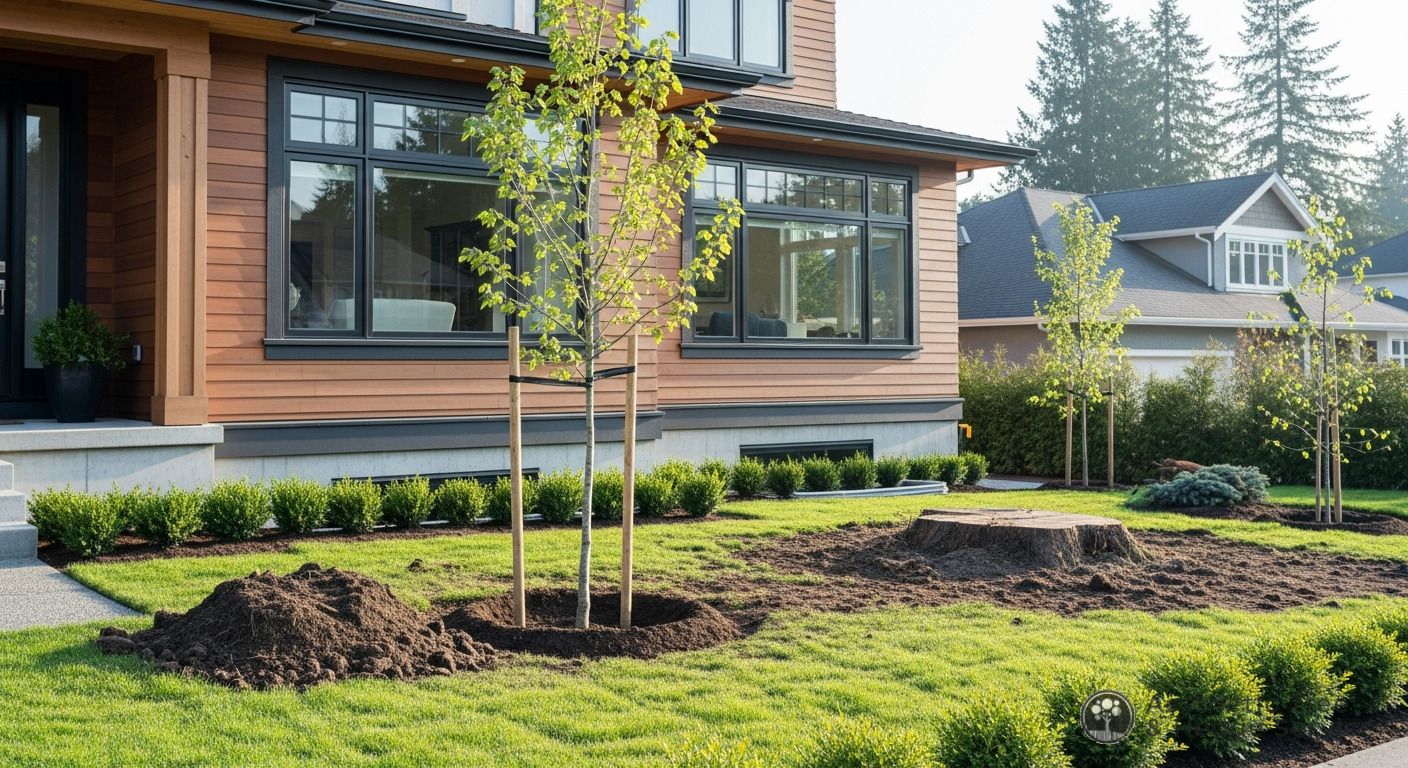
As a practical rule, avoid planting directly over the old stump grind. Shift the new tree outside the densest decay zone when you can. On many residential sites, that means several feet away. On tight lots, an arborist may adjust the plan and rebuild the soil more carefully.
Distance also depends on nearby targets.
Targets are things a tree can hit, lift, shade, or conflict with. Houses. Garages. Driveways. Hydro lines. Sewer laterals. Fences. Neighbouring structures. Play areas. Sidewalks.
If the removed tree came out because it was too close to the house, don’t repeat the same error. Pick a species and spot that reduce future conflict.
Root barriers can help in some cases. They are not magic. They must be used with the right species, soil, and layout. A root barrier installed in the wrong place can redirect roots into another problem.
If hardscape conflict is the concern, ask about root barrier installation before planting.
Can You Plant After Removing a Diseased Tree?
Yes, but the disease matters.
A tree removed for storm damage is different from a tree removed for root rot. A tree removed for construction clearance is different from a tree removed for fungal decay at the base.
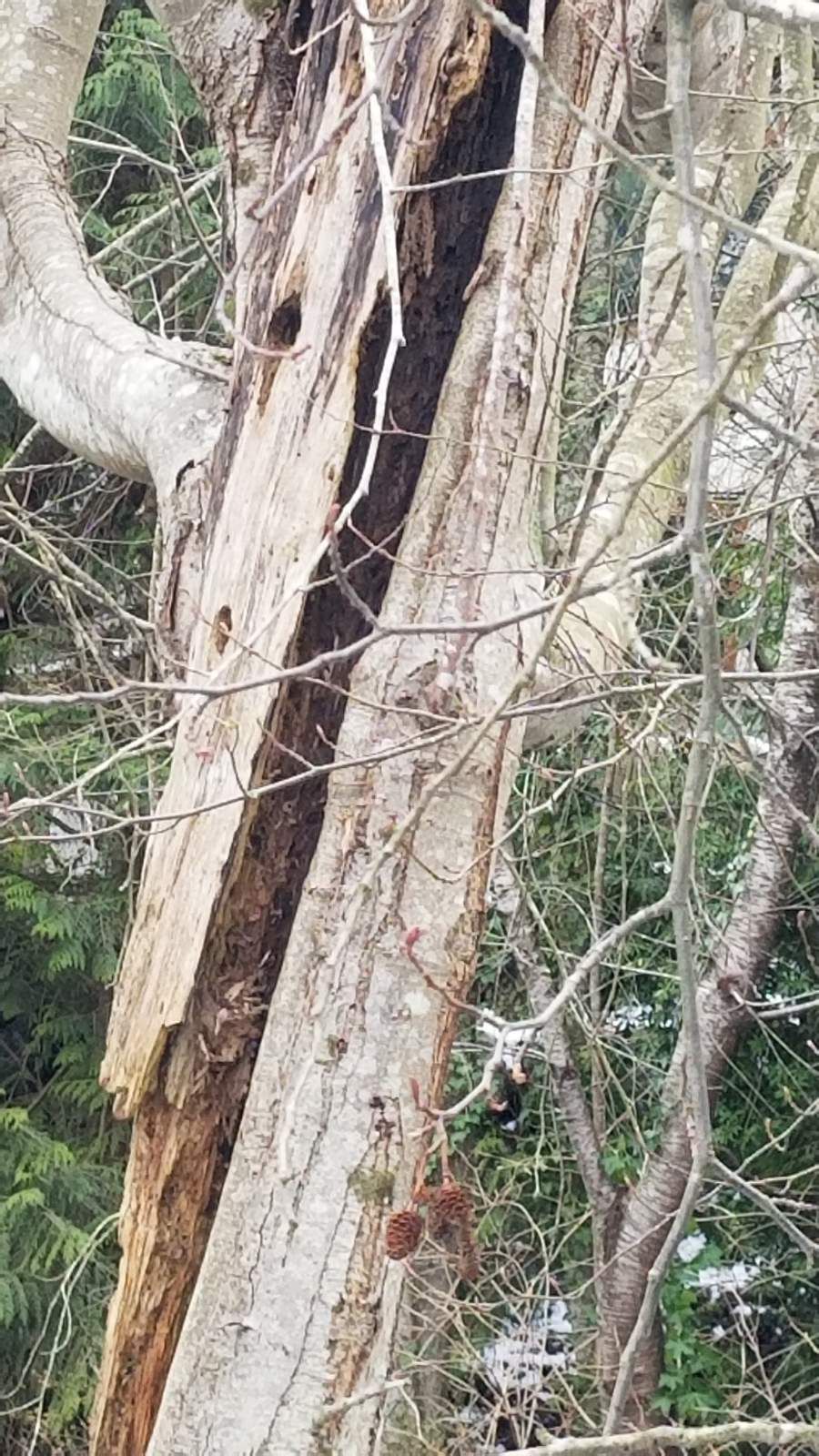
If disease was involved, don’t plant the same species in the same spot without advice. Some pathogens persist in roots and soil. Some affect a narrow range of hosts. Others affect many woody plants.
This is where homeowner guesswork gets expensive.
A cedar hedge that failed from poor drainage tells us one thing. A mature maple with basal decay tells us another. A fruit tree with canker tells us another. A declining birch in hot, dry soil tells us another.
The replacement plan should answer:
- What killed or weakened the old tree?
- Is the problem still present?
- Will the new species resist that issue better?
- Does the soil need correction?
- Should the new tree move to a new spot?
- Should the site be planted with a different form, such as a hedge or smaller ornamental tree?
For hazard trees, safety comes first. If a tree is cracked, leaning, uprooting, or storm-damaged, call for emergency tree service before thinking about replanting.
Once the risk is controlled, then plan the replacement.
What Soil Prep Helps a New Tree Survive After Removal?
Good planting soil is loose enough for roots, firm enough for support, and alive enough to hold moisture without staying soggy.
That sounds basic. It isn’t.
After removal, soil is often compacted by equipment and foot traffic. It may contain stump grindings. It may have old roots, construction debris, poor drainage, or low organic matter.
Start with the planting area, not just the hole.
A common mistake is digging a deep, narrow hole and filling it with rich amended soil. That creates a bathtub effect. Water collects. Roots circle. The tree stays in the soft pocket instead of moving into native soil.
A better planting hole is wide and shallow. The root flare sits at finished grade. The root ball rests on firm soil. The sides are loosened. The top is mulched properly.
Mulch helps when it’s done right.
The ISA and many university extension programs warn against piling mulch against the trunk. Mulch should not touch bark. Keep it pulled back from the root flare. Think wide ring, not volcano.
Aesthetic Tree offers mulching services when a site needs moisture control and root-zone protection after planting.
Watering matters even more. Newly planted trees need consistent water through establishment. The Arnold Arboretum at Harvard notes that newly planted trees and shrubs receive extra care for their first three years. That three-year window is a good reminder for homeowners.
Planting day is not the finish line.
It’s the start of establishment.
How Do Vancouver’s Tree Canopy Goals Affect Homeowners?
Tree canopy sounds like a city planning term. But it affects your yard.
Metro Vancouver tracks canopy because trees cool streets, slow stormwater, store carbon, filter air, and improve neighbourhood health. When canopy drops, heat rises. Stormwater pressure rises. Habitat drops.
Metro Vancouver’s tree canopy monitoring reported a 1% decline in canopy cover within the Urban Containment Boundary from 2014 to 2020. That may sound small. Across a region, 1% is a lot of canopy.
Vancouver has moved in the other direction in recent reporting. The City’s 2024 canopy update said canopy cover grew from 23% in 2018 to 25% in 2022. The longer 2022 assessment also showed canopy at 25% citywide.
Burnaby’s 2025 Urban Forest Strategy reports 32% canopy cover, equal to about 2,900 hectares.
Those numbers explain why cities care about replacement trees. One yard at a time, private property shapes the urban forest.
That doesn’t mean every yard should hold a giant tree. It means every replacement should be planned well.
A healthy smaller tree that lives 40 years beats a large species planted in the wrong place and removed in 8.
Should You Replace a Removed Tree With a Hedge Instead?
Sometimes, yes.
A hedge can solve privacy, screening, and boundary needs without creating the same overhead risk as a large tree. But hedges still need species choice, spacing, and long-term care.
Cedar hedges are common across Vancouver, Burnaby, and Richmond. They also fail when planted in poor soil, deep shade, drought stress, or tight strips beside pavement. Laurel, yew, beech, and other hedge plants have their own site needs.
If the removed tree was blocking sightlines, damaging a fence, or outgrowing a small yard, a hedge may be a better replacement form.
But don’t plant a hedge over fresh stump grindings and expect a clean result. Hedge roots still need soil. They still need water. They still need spacing.
If the goal is privacy after removal, compare hedge installation with a single replacement tree. If you already have a hedge near the removal site, proper hedge trimming can also bring light and structure back into the yard.
The right answer depends on what you need the plant to do.
Shade? Privacy? Screening? Wildlife value? Permit compliance? Root control? Wind protection?
Name the job first. Then pick the plant.
What Mistakes Make Replacement Trees Fail?
Most replacement trees fail for boring reasons.
That’s good news. Boring reasons can be fixed.
The common mistakes are:
- Planting too deep.
- Burying the root flare.
- Planting directly into stump grindings.
- Choosing a species that gets too large.
- Ignoring drainage.
- Under-watering in the first three summers.
- Over-mulching against the trunk.
- Leaving circling roots uncorrected.
- Staking too tightly or too long.
- Planting too close to buildings or utilities.
- Replanting the same species after disease.
- Treating a permit replacement as a box to check.
The last one matters.
A replacement tree is not just paperwork. It is a living structure that adds weight, roots, shade, wind load, and future maintenance to your property.
That’s why arborist planting looks different from basic landscaping. We think about mature structure. We think about clearance. We think about root flare, root defects, soil volume, and ANSI A300 standards.
We also think about removal history.
Why did the last tree come down?
If the answer was “too big for the space,” the replacement should not be another future conflict.
When Should You Call an Arborist Before Replanting?
Call an arborist when the old tree was large, protected, diseased, close to structures, close to utilities, or removed under permit.
Also call when you’re unsure.
That’s not a sales line. It’s a risk line.
A wrong replacement can cost years. You water it. You mulch it. You watch it struggle. Then you remove it and start over.
An ISA-certified arborist can check:
- Permit and replacement conditions.
- Old stump and root location.
- Soil and drainage.
- Species fit.
- Planting depth.
- Root flare position.
- Clearance from structures.
- Utility and hardscape conflicts.
- Long-term pruning needs.
- Hazard concerns from nearby trees.
If the removal work has not happened yet, start with a proper assessment. Aesthetic Tree provides tree cutting, removal, stump grinding, arborist reports, and planting support. That keeps the full sequence connected.
Removal affects planting. Planting affects future pruning. Future pruning affects structure and safety.
It’s all one system.
For seasonal timing, our guide to seasonal tree care is a helpful next read.
FAQ
Can I plant a new tree where the old stump was ground out?
You can, but it’s often better to move the new tree away from the old stump area. Stump grindings, old roots, decay, and settling soil can make the exact spot harder for a young tree. If space is tight, remove excess grindings and rebuild the planting area before planting.
What tree should I plant after removing a cedar?
It depends on why the cedar came out. If it failed from drought, shade, or poor drainage, another cedar in the same spot may fail too. Consider soil moisture, light, mature size, and city rules first. Vine maple, Pacific dogwood, shore pine, or another site-suited species may fit better.
Do I need a permit to remove and replace a tree in Vancouver?
For many trees, yes. Vancouver requires permits for protected private trees, and replacement planting is often required for removed trees over 20 cm diameter. Always check current city rules before removal. An arborist report may be needed for hazardous, protected, or development-related trees.
How soon should I water a replacement tree after planting?
Water right after planting. Then keep watering through the establishment period, especially during dry spring and summer weather. Young trees need consistent moisture, not daily flooding. Check the root ball and surrounding soil. Dry root balls kill new trees fast.
Is fall or spring better for replanting in the Lower Mainland?
Fall is often best because rain returns and heat stress drops. Roots can establish before summer. Spring also works if you commit to watering through dry weather. Avoid planting during frozen soil, saturated soil, or summer heat waves unless there is a clear watering plan.
Replanting after tree removal is not just filling a gap. It’s a chance to fix the reason the last tree failed, meet local bylaw rules, and plant something that fits your property for decades.
Call Aesthetic Tree & Hedge Services for a free estimate at (604) 721-7370. Our ISA-certified arborists are WCB registered and ready to help with removal, stump grinding, arborist reports, and replacement planting across Vancouver and the Lower Mainland.
Found this helpful? Follow our tree care insights directly on Google.
Make us your preferred source on GoogleBefore You Go
Where are you in your tree care journey?
Our Tree Care Services
ISA-certified arborists serving Greater Vancouver


Explore Our Tree Care Services
From expert pruning to safe tree removal, our ISA-certified arborists are ready to help across Greater Vancouver.
View Services